I cannot believe I haven’t posted anything from my trip to Australia last year, so here’s a starting point in the form of a Haiku, based on an image that you may not expect from a tourist (although it is a lesser-known UNESCO Heritage site):
I have visited Washington, DC several times over the years but I must admit I had never walked around the Tidal Basin in its entirety and visited the Memorial to Franklin Delano Roosevelt. This tribute to FDR and his four terms as a US President is quite unusual. A strikingly different approach was taken in its design when compared to the somewhat more traditional (and arguably more photogenic) edifices built as homages to Presidents Washington, Lincoln and Jefferson.
FDR was an interesting president, hiding his disability at a time when it would have been considered weak to be anything less that an idealized “true man.” He was far from perfect, as the lack of dealing with racial equality on his watch attests, but he did make significant changes to the American way at a time of great turmoil and hardship, leading the nation through both the aftermath of the Great Depression and World War II.
The memorial is arranged to explore each of his four terms in office and, among the walls and sculptures contains several pieces of text carved into the marble. One of these quotes struck a chord with me for it’s prescience, and in my opinion, should also be reproduced over the doorway of the Oval Office so that every occupant, of every political persuasion, can contemplate it when seated at their desk.
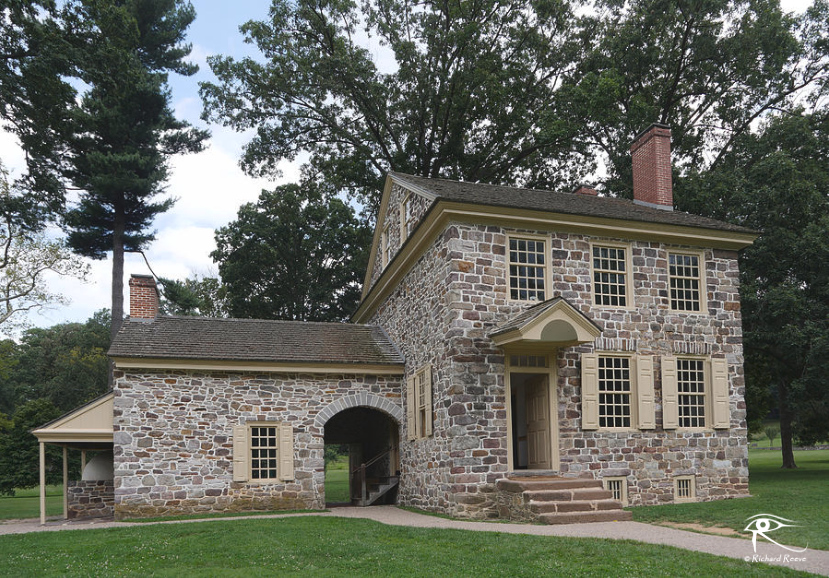
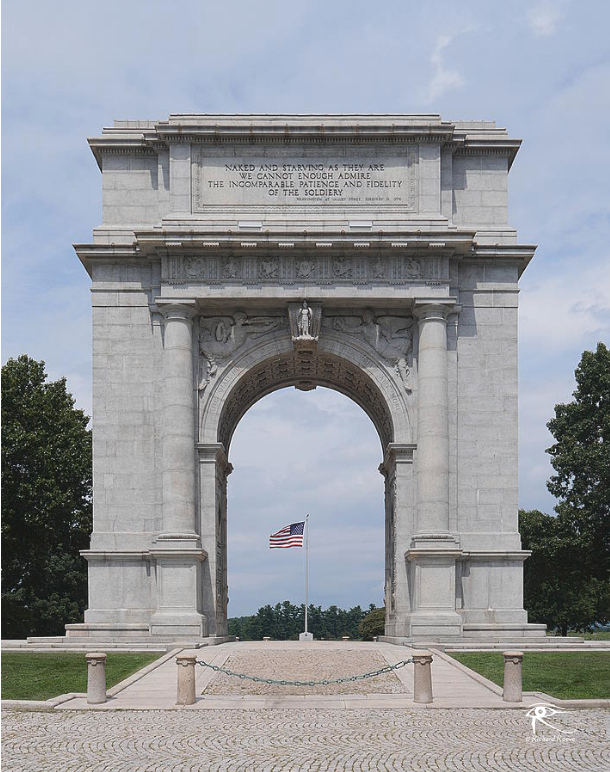
I hadn’t picked up my camera for over a month, but yesterday I had the opportunity to visit Valley Forge National Historical Park with my daughter and her friend. We hired bicycles for two hours and cycled around 9 miles through this beautiful area. It was hard work on some of the unpaved trails but well worth the effort.
There were no battles fought at Valley Forge, but lack of supplies was so severe that starvation and disease saw 2,500 men and over 700 horses dead during the six months the Continental Army was encamped there from December 1777 to June 1778.
Yet, despite the appalling living conditions, the Continental Army was transformed from a rebellious force into a fully fledged army that was eventually able to fend off the British Army and allow the colonies to establish themselves as an independent nation.
How?
The weather in February 1778 eased and became milder, alleviating some misery and Washington’s appointment of the resourceful General Nathaniel Greene as Quartermaster enabled better supply lines to be established. Successful petitioning of the Continental Congress finally allowed funding for the army and then, in March 1778, the mercenary ex-Prussian Army drill-master “Baron” Friedrich Wilhelm von Steuben arrived at camp. Though he spoke no English, von Steuben, with the help of translators, and due to his peculiar style of actually interacting directly with the men, was able boost morale and to train the American soldiers. His work became “The Blue Book” (Regulations for the Order and Discipline of the Troops of the United States) and would remain as the official training manual for over 30 years.
With the Treaty of Alliance with France signed in February 1778, ensuring supplies and support, and a well trained army behind him, Washington was able to leave Valley Forge after six months and face the British.
The town of Harwich, situated on the mouth of the the Rivers Stour and Orwell has been an important port for centuries. The town’s name derives from the Old English here-wic, meaning “military settlement” and received its charter in 1238, although it is likely it was established long before this time.
The Royal Navy established a dockyard here in 1652 for around 60 years, and although there is no longer a navy presence here the port was important during World Wars and has been an important commercial port for “travel to the continent” for decades. There is a large area we used to simply refer to as “The War Department” as a kid which is filled with reinforced concrete bunkers, towers and gun emplacements and was a wonderful place to play as child. I recall stories being told of how the guns there shelled the German battleship Scharnhorst when it passed along the coast, although I cannot verify them.
There is also an older fort, simply called The Redoubt, that was built in 1809-10 to defend against Napoleon, which again emphasises the strategic position of the town over the centuries.
Harwich is also famous for being the birthplace of not only the Captain of Mayflower, Christopher Jones (c. 1570) but also the famous ship itself. The Mayflower, which went on to carry The Pilgrims to the New World, was likely built at Harwich and was certainly registered as being “of Harwich” in the 1609-11 Port Books.
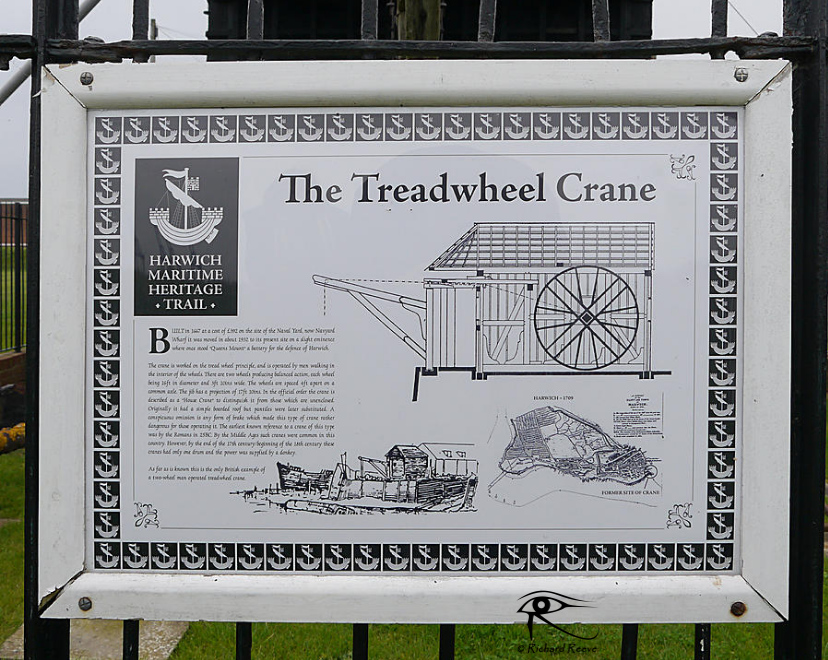
A walk along the docks and port of Harwich to Harwich Green also reveals an unusual building – the treadwheel crane. Using mechanics that was largely unchanged since the Roman period this is a human-powered lifting device was built in 1657 in the Naval Yard. It was moved to the Green in 1932, and is the only double wheel treadmill crane in Britain. It fascinated me as a child, and seems to stand as a sort of testament to past labour associated with the town.
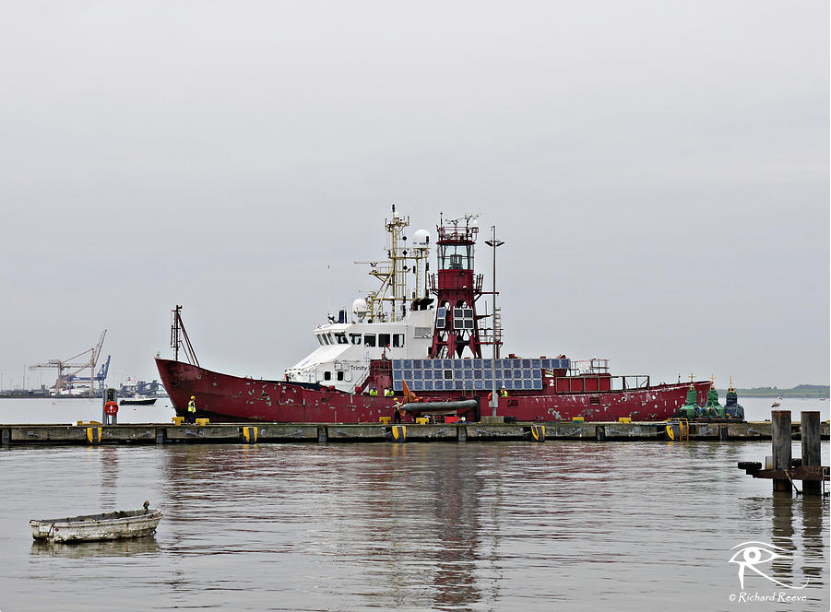
Trinity House, the official keeper of lighthouses and deep sea pilotage, has been an important part of the town for a long time with pilot boats guiding vessels into the ports and lightship and buoy maintenance being conducted here.
Unlike many coastal towns, Harwich never really became a seaside resort, maintaining its position as a “working town” and letting the neighboring town of Dovercourt take the tourists.
Nevertheless, it’s not all work, and there is fun to be had if you look for it…
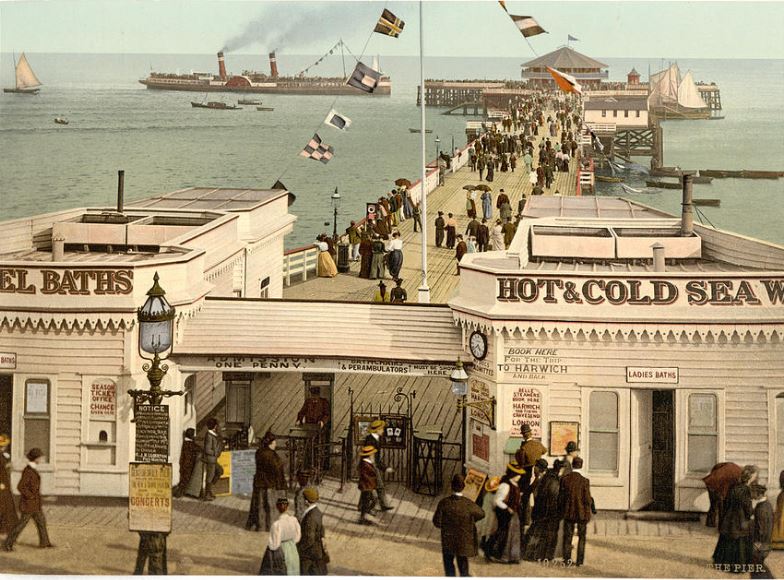
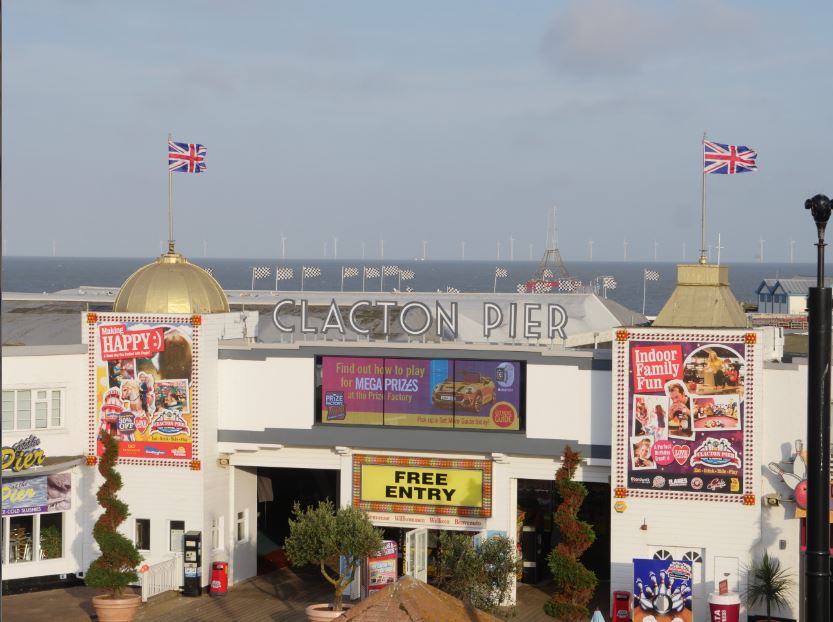
Nestled on the Tendring peninsula on the east coast of England, and providing seaside entertainment for the masses for over 150 years, the town of Clacton may seem like any other British seaside town. Clacton came to prominence in 1871 when it was founded by Peter Bruff as a seaside resort, largely for Londoners to escape the city. He built the pier, which still stands today, and steamer was the main method of reaching the town until the road and rail system caught up.
The heyday of the town was really the middle decades of the twentieth century when there was a Butlins Holiday Camp and many hotels and guest houses to entertain the day trippers and summer holiday makers. Then along came cheap flights to more exotic locations and, like so many British resorts, there was a significant downturn in the economy.
Even in the 21st century the town still has a significant number of visitors and people enjoying the sandy beaches, and going on the rides and other amusements on Peter Bruff’s original pier. When we were kids there were dolphins and orcas kept in the swimming pool on the pier, but thankfully that’s gone now.
The landscape has also changed a bit with the offshore wind farm on Gunfleet Sands but all in all a pretty standard town that has had its ups and downs…
… Or is it?
Well, there are two things that are also uniquely interesting about this town, so let me explain.
Firstly, Clacton was the site of the first civilian casualties in World War II when Frederick and Dorothy Gill were killed by a Heinkel bomber that crashed into their house on May 1st, 1940. Little is made of this fact, although I clearly recall a plaque on a bench on nearby Skelmersdale Road detailing this tragedy when I was a teenager.
Secondly, although Clacton is primarily known as a typical Victorian seaside town, the area slightly inland at Great Clacton was inhabited by the Celts and there is some evidence of Roman involvement too at the coast. The most amazing fact though is that during the paleolithic period, the area was used for flint mining and tool manufacture. And in 1911 there was uncovered the “Clacton Spear” a wooden yew spear which, at 420,000 years old is the oldest known wooden tool created by man. It is, in fact, even older than Homo sapiens and was carved by our pre-ancestors Homo erectus. An entire period of human development, Clactonian, was named after the town and describes the fascinating industry of flint working and tool making.
By Chemical Engineer (Own work) [CC BY-SA 4.0 (http://creativecommons.org/licenses/by-sa/4.0%5D, via Wikimedia CommonsI lived in Clacton during my teenage years and was totally unaware of this significant piece of our history. Sometimes it truly amazes me how understated the British people can be. In many other places in the world both these events would have been used to develop another aspect of the town, with museums and themed activities, but not in this corner of Essex.
At the end of the day, or perhaps with an appropriate lunch or dinner, a little drop of claret goes down well. Claret, of course, in the quintessentially British term for red wines produced in the Bordeaux region of France, using a blend of grapes from Cabernet Sauvignon, Cabernet Franc, Merlot, Petit Verdot, Malbec and rarely Carménère. The term is believed to derive from the French word “clairet” which was a dark rosé imported into Britain from the 12th century until the 18th century. Claret now really means a dry, dark red Bordeaux and is generally associated with the English upper class.
So, in Ian’s lyrics he was probably referring to the ability to get hold of “a little drop of claret” as something of a treat for most people and therefore a true “Reason to be Cheerful”
I also thought it would be fun to use one of our Tipsy Wine Glasses for today’s image, a recent xmas gift from our friends in California.
For any British readers today is a significant date, for it is the day when, in 1605 Robert Catesby’s plot to destroy the English Parliament using gunpowder was foiled. One of the conspirators, Guy Fawkes was caught red handed guarding barrels of gunpowder that had been placed under the House of Lords so that it would kill everyone inside. The plot uncovered, Guy Fawkes was subjected to terrible torture and, along with his co-conspirators, executed.
Subsequently, throughout Britain the public have celebrated this date as “Guy Fawkes Night” or “Bonfire Night” when large community bonfires are built, usually with an effigy (“guy”) set atop, and fireworks are set as celebration. The ancient rhyme is also recited, or at least it was when I was a kid:
Remember, remember, the 5th of November The Gunpowder Treason and plot; I know of no reason why Gunpowder Treason Should ever be forgot.
We always looked forward to the fireworks, the huge bonfire, and also the tradition of children making their own guys and then attempting to collect a “penny for the guy” in order to be able to raise cash to buy fireworks. I don’t think this happens so much anymore, at least the children buying fireworks part.
Another more modern development is the use of current figures of hate on the bonfires. Ironically, the British Prime Minister has been the target on several occasions, and I recall Margaret Thatcher and Tony Blair being featured, but often there are international guys too, such as foreign “dignitaries” who have particularly struck a negative cord with the British populace.
One of the oldest and largest Guy Fawkes Festivals is the Lewes Bonfire Night Celebration which takes place in the tows, East Sussex. Here there are several competing societies that plan their effigies for months and compete in a parade followed by a series of bonfires.
As an American citizen, of British heritage, I can only remark on how fitting that this should be celebrated a mere 3 days ahead of US election day 2016, a situation that has not escaped the teams at Lewes in their choice of effigies to burn this year.
As we near the end of the school year I was prompted, whilst listening to NPR on the way to work, to compose a rant about the American obsession with not letting go of the old agrarian school calendar and the ludicrously lengthy summer vacation.
As someone who comes from a different educational culture I have always found the extended break to be problematic. In the UK we are used to having a schedule of six-weeks at school followed by a week or two off school, with a longer 5-6 week break covering the end of July through to early September. This allows kids to “let off steam” throughout the year.
In the US system I have struggled with my children having to continue through the school year with very few breaks* so that they can all be stacked up in the summer. This relentless routine doesn’t seem to allow them any respite time during the year and the summer is a lengthy period which, I am convinced, serves as an opportunity to forget what has been learned.
However, in researching what I considered to be an obsession with a throwback to an agrarian lifestyle, I found that my preconceptions and acceptance of this generally held belief are incorrect. It is oft quoted that we have the whole summer off because of the historical need for children to help on the farms during the times of harvest, however this is apparently not the case. For example, logically the busiest times of the year are the Spring (for crop planting) and the Fall (for harvesting) so letting students out of school during the height of growing season doesn’t really make a lot of sense from a labor-source perspective. In fact, at one point older rural American school systems used to take the students from school during these times and send them back to school during the summer! It is a touch ironic that one reason quoted for the long summer vacation is actually due to increasing American urbanization during the late 19th century and early 20th century rather than the rural lifestyle – the direct opposite of our well-held belief!
Hot summers and lack of air-conditioning made the new cities uncomfortable to remain in and therefore the more prosperous wanted to retreat to the coast or country to escape this situation. Similarly, the urban schools were just too hot for the students to concentrate on their lessons.
There does seem to be more discourse on this subject recently, although a search on the web indicates it has certainly been discussed for decades and, like anything that impacts our “tradition” there will always be staunch supporters to counter any thoughts of reform.
All this being said of course, I still think that US school year needs to be altered so that the students get more, shorter breaks that allow them to recoup their energy and mental faculties. But then, my children are going to be out of the school system in the blink of an eye, so I guess I’ll just grit my teeth for a few more years…
~Richard
* Our Spring Break is now just 3 days in our school district and Christmas break starts on Dec 23rd
I created this artwork over six months ago when the Republican “race for nomination” was already well underway. It has been a long haul so far and is now going to become even more interesting…
“A picture is worth a thousand words” is not, as oft thought, an ancient saying from a mystical eastern philosopher, but rather a construct of the advertising manager at Street Railways Advertising, Frederick R. Barnard.
In an advertisement in “Printer’s Ink” in December 1921 he used the phrase “One Look Is Worth a Thousand Words” with a fictional attribution to “a famous Japanese philosopher” to add gravitas to his copy which was, in the end, designed to sell photographic advertisements rather than to be particularly philosophical.
That being said, today I offer up perhaps one fortieth of my picture of the Republican front runner in the 2016 GOP presidential campaign:
Adventuring the globe whilst based in the beautiful PNW, with a focus on fitness & adventure travel, conservation and a healthy balanced lifestyle. All with my beautiful partner in crime, Stephanie!














 searching4theshot