Rules of the Road and the Culture of Driving

OK I admit it, I’m a bit of a driving snob. This is largely due to having spent the first four decades of my life in the UK, with one of the most difficult driving tests, strictly enforced rules and, consequently, very low road death and accident rate. Then we moved to California and I had to take my California Driver’s “test” which involved driving about 2 miles, making a few stops and turns before I was handed a license. I thought it was a joke until we moved to Pennsylvania where the same test consists of reverse parking a vehicle into a space large enough for an airplane to park and then driving through a parking lot and approximately 100 yds of road.

I still find it astonishing that that a 16-year old can take this “test” of their driving competency and then hop into a Hummer and drive it across country. And not only drive it, but do so in such an aggressive manner. It’s as if every US driver thinks the road is theirs and theirs alone, with little concept of braking distance and the dangers of tailgating.

So, that being said, I have been amazed this week by the driving in and around Chennai, India. The roads are chock full of mopeds, motorcycles, auto-rickshaws (tuk-tuks), cars, buses, trucks and of course people and the odd cow wandering through. It is fascinating to watch how this all works. And work it does. Many vehicles have a “sound horn” sign on the rear and it is quite expected to drive along and, when obstructed, simply press the horn to warn the other rider/driver/pedestrian that you are there. Amazingly, the other road users all heed the warning and move over, which is useful as road markings seem to serve little purpose here leading to 3 or 4 vehicles occupying 2 lanes.

I am unsure how it works, but it is truly a demonstration of collective teamwork on a huge scale. Unlike in the US or Europe the car horn here does not seem to be used aggressively and other road users seem to just “get on with it.” As I sit in my car I am somewhat awestruck by how my driver navigates his route (no, there’s no way I am going to drive myself here!) with relative ease. Yesterday we came face to face with several trucks in the middle of the road (and more cows) as we heading from one town to another and yet it all seemed to work smoothly.
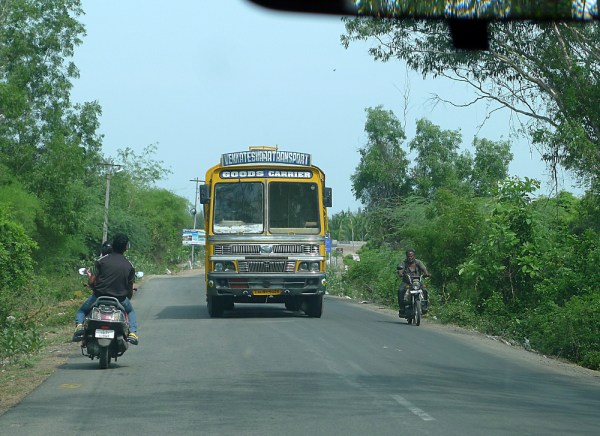
P1130173_Truck1000

I cannot imagine this sort of holistic driving approach working elsewhere and conversely, I wonder how Indian drivers find the driving in the US or Europe?
~Richard

Ethical tipping?

Giving small gratuities or tips to people for providing a service is part of many cultures whilst being considered offensive in others (e.g., Japan).In some cultures a tip is expected for certain activities, and indeed is factored into the expected income even by the tax authority (e.g., waitresses in the US), whereas in others a tip should be given only for exceptional service above and beyond the expected level.

I used to travel a lot on business from the UK, which does not have a particularly strong tipping culture outside of certain roles, but having lived and worked in the US for several years I now always made a point of tipping cab drivers, bell hops, maid service and waitresses. However, on my recent trip to India I was faced with another dilemma – how much to give as a tip when there is such a discrepancy between local and tourist wealth?

I don’t want to be mean, but on the other hand I don’t want to offend by appearing brash and giving the impression I think that the local currency is of low value. To be honest it’s all rather confusing

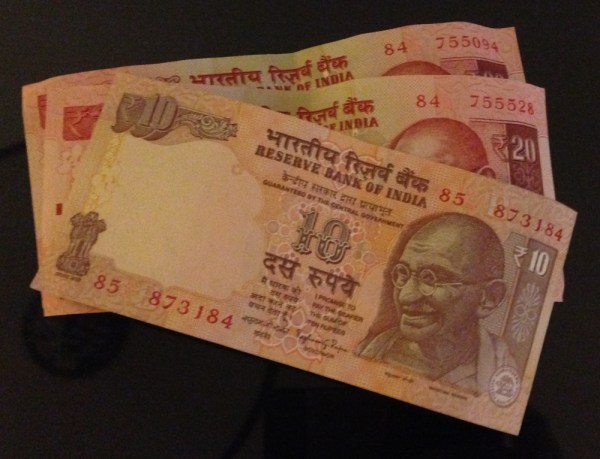
For example, I asked at the hotel reception how much would be a good tip for a taxi driver, as was told that it is 65 rupees to the dollar so about 60-100 rupees would be a good tip. So, when the driver dropped me off in town in the early morning I handed him a 100 rupee note and he then said he would wait for me to return, even though I wasn’t coming back to be collected for nearly 4 hours! I don’t know if this was what he planned anyway or whether it was because of the tip, and I admit I had mixed feelings about having him wait that length of time just for me.

IMG_3934_Rupees1000

A check on the web revealed that an IT business Analyst earns somewhere between $3,500-$14,000 per year, an IT Project Manager $9,500-$25,000 and a Customer Service Manager $12,000-$18,000; while a waiter may earn $1,500-$2,500.

So, to my dilemma: there seems to be no issue with the hotel in which I am staying charging Western-style prices to foreign guests for room and restaurant ($180/night and about $40 for dinner + taxes) yet clearly the staff is not paid western-style salaries.

If someone is earning under $10 per day is it appropriate for me to tip them 20-30% of their daily salary for cleaning my room? I really don’t know. So, I went with my conscience and left 100 rupees ($1.50) the first day and it was accepted. However, on the second day it was left untouched. I don’t know why. I left 50 rupees for the next few days and it was accepted, even though it seems mean to me…

I remain confused and if anyone has any suggestions or comments I would welcome them.

~Richard

PS: since writing this post I brought up the issue of tipping with some Indian colleagues and they told me that tipping is not generally expected in India, thus adding to my confusion as i had read that is was expected… sometimes… !

Waiting for a bus, paradoxically

As I was being driven back my hotel through the crowded streets of Chennai in the evening rush hour, I couldn’t help but think of the paradoxes that seem to surround India. People wait for crowded, dented buses on tired, broken streets to enter the erratic, noisy traffic whilst many others (locals and foreigners)  can indulge in opulent gestures.

‘Twas ever thus.

This composite image captures some of my thoughts from today’s journey.

160530_ChennaiBus

~Richard

On the Pale Ale Route

India Pale Ale, or IPA, is a strongly hopped beer developed in the late 18th century specifically for the East India Company by Allsop brewery from the existing pale ales. The extra hoppiness made it particularly suitable for the long sea voyage to India and it was quickly followed by many other brewers and found f(l)avor with the expats stationed in the subcontinent.  Charrington’s first shipment of their India Ale to Madras (modern day Chennai) in 1827 was so successful that a regular trade was soon established.

The original term pale ale comes from the lighter colored beer that was produced by warm fermentation of pale malts that had been predominantly dried coke. Apparently the world’s first pale ale was produced by Bass, which was the best selling beer in the UK and exported throughout the Empire with its distinctive red triangle branding (and Britain’s first trademark!).

How ironic (or simply coincidental) then that the only British beer available to me in the BA lounge on my trip to Chennai tonight is Bass Pale Ale!

IMG_3891

Of course my journey, though starting 3000+ miles further west, will be completed in under 24 hours, something those 18th century British merchant sailors would have thought as impossible as they crossed the treacherous ocean to deliver their happy hoppy cargo.

~Richard

But is it an Agrarian Vacation Schedule?

As we near the end of the school year I was prompted, whilst listening to NPR on the way to work, to compose a rant about the American obsession with not letting go of the old agrarian school calendar and the ludicrously lengthy summer vacation.

160523_SchoolsOut
As someone who comes from a different educational culture I have always found the extended break to be problematic. In the UK we are used to having a schedule of six-weeks at school followed by a week or two off school, with a longer 5-6 week break covering the end of July through to early September.  This allows kids to “let off steam” throughout the year.

In the US system I have struggled with my children having to continue through the school year with very few breaks* so that they can all be stacked up in the summer. This relentless routine doesn’t seem to allow them any respite time during the year and the summer is a lengthy period which, I am convinced, serves as an opportunity to forget what has been learned.

However, in researching what I considered to be an obsession with a throwback to an agrarian lifestyle, I found that my preconceptions and acceptance of this generally held belief are incorrect. It is oft quoted that we have the whole summer off because of the historical need for children to help on the farms during the times of harvest, however this is apparently not the case. For example, logically the busiest times of the year are the Spring (for crop planting) and the Fall (for harvesting) so letting students out of school during the height of growing season doesn’t really make a lot of sense from a labor-source perspective.  In fact, at one point older rural American school systems used to take the students from school during these times and send them back to school during the summer! It is a touch ironic that one reason quoted for the long summer vacation is actually due to increasing American urbanization during the late 19th century and early 20th century rather than the rural lifestyle –  the direct opposite of our well-held belief!

Hot summers and lack of air-conditioning made the new cities uncomfortable to remain in and therefore the more prosperous wanted to retreat to the coast or country to escape this situation. Similarly, the urban schools were just too hot for the students to concentrate on their lessons.

There does seem to be more discourse on this subject recently, although a search on the web indicates it has certainly been discussed for decades and, like anything that impacts our “tradition” there will always be staunch supporters to counter any thoughts of reform.

All this being said of course, I still think that US school year needs to be altered so that the students get more, shorter breaks that allow them to recoup their energy and mental faculties. But then, my children are going to be out of the school system in the blink of an eye, so I guess I’ll just grit my teeth for a few more years…

~Richard

* Our Spring Break is now just 3 days in our school district and Christmas break starts on Dec 23rd

What’s your magic twitter number?

I am not a big twitter user, but I do use this platform to post once a day on average in order to maintain a light presence there. Although I had an account for years I only really started using it relatively recently as a promotion tool for my photography/art website but I do also post other things that pique my interest.

Twitter_logo_blueAt least that’s how it started. These days my postings are really only back to this blog rather than to my website, so I know I am doing it all wrong from a marketing perspective but, to be honest, it’s probably saying more about

me and how I have developed “on the web” over the last few years. All that being said, for the last 5 months or so I have been keeping an eye on the number of followers that I have accrued, and there’s a pattern. I seem to hover around the same number, only once going above it to my recollection. I drop by up to a dozen followers over the week and then pick up again in a sort of “revolving door” of community.

When I started on this tweeting malarkey I, like many others I suspect, used to follow and unfollow rigorously in a sort of “tit-for-tat” fashion and I suspect that may be what is happening to me – someone follows me and I don’t follow back so they drop me. I do try to follow people back but I have become more discerning these days as I only really want to see tweets that are likely to interest me.

So, I can reveal that my magic twitter number seems to be 1190.

1190

Does anyone else experience the same phenomenon, and if so would you like to share your magic number?

~Richard

Paraskavedekatriaphobia and more…

Today is Friday the 13th, a day full of fear for those who suffer from triskaidekaphobia, the irrational fear of the number 13, and an extremely  rare scrabble word. If that were not enough there is even a subset of quivering individuals who suffer from paraskavedekatriaphobia, specifically the fear of Friday the Thirteenth.*

Personally, I have no issue with superstitions and I find it quaint that people will go out of their way to avoid certain activities or places because of these afflictions. Corporations even pander to this on occasion: how often do you see a room 13 or 1313, or even a floor 13 in some hotels? This of course makes no logical sense and is somewhat called into question when examining such superstitions across the globe. For example 13 in China is considered a lucky number! Go figure the logic…

One other superstition that always amuses me is that associated with the black cat. Again, in some cultures they are considered lucky whereas in others they are seen as harbingers of bad omens, to the extent that they have been persecuted historically.

As an owner (or adopter in modern parlance) of a black cat I offer up an antidote to all this superstition through this depiction of our own roaming feline. Some days are lucky with him, others not so.

Of course for most of the rodents he meets at night it is a very unlucky day indeed …

160513_Misty

*pointless factoid – Friday the thirteenth can only occur in a month that starts on a Sunday.

~Richard

Men’s Health

Tomorrow I need to get stuck like a porcupine as I get myriad vaccinations for a trip to foreign climes that has been sprung on me by my corporate overlords. Unfortunately my records aren’t up to date, and my memory is unreliable for this type of thing so I shall have to have a raft of these to ensure coverage. And yes, as a biologist with some history in medical microbiology and human immunology, I wholeheartedly ascribe to the effectiveness of this tried and tested preventative medicine as exemplified by Jenner back in the late 18th Century.

The same cannot be said for the quackery that surrounds the scientifically untested homeopathy, and various other “alternative” or “complementary” therapies which, in my opinion provide only a placebo response at best,  but this got me thinking about all those old advertisements for patent medicines that filled the newspapers of the past.

160512_MensHealth

It’s interesting just how many men from the Edwardian era seemed to require remedies from certain types of diseases, some real and others not so much 😉

Oh how things have changed… or have they?

~Richard

Patently Obvious?

It always amazes me that there is a regular and consistent market for framed patent drawings from bygone years. I wonder if it is a fascination with technical drawings, or perhaps just a sense of nostalgic escape from our modern  technology-filled world. Perhaps it would even explain the rise of the concept of “steam punk” over the last few decades. I mention this only because I recently stumbled across the novel “The Difference Engine,” which is a collaboration between William Gibson and Bruce Sterling. I am unfamiliar with the writings of Sterling but this seems to me to be a big departure form Gibson’s usual mind-bending, cerebral work.

Anyhow, this prompted me to resurrect the patent drawing of George Stephenson’s Locomotive nearly 200 years ago, which I have tidied up a bit.

160510_StephensonLocomotive

~Richard

Happy Mother’s Day

Back in March I wrote a post on Mothering Sunday for my UK friends. Now it is the turn for my American friends: Happy Mother’s Day!

160508_MothersDay

~Richard

Blog at WordPress.com.

Up ↑

MrReid.org

Stuff that interests Mr Reid, a physicist and teacher

From 1 Blogger 2 Another

Sharing Great Blog Posts

Journeys Through Pre-World War 3 Britain

Travelling the overcast isles

cancer killing recipe

Inspiration for meeting life's challenges.

the poet's billow

a resource for moving poetry

Lordess

Welcome to my world.

Rustic Rumination

Mind over matter

Stephen Liddell

Musings on a mad world

thisisyouth

Travel. Climbing. Characters. True stories, well told.

OPOD blog

Adventuring the globe whilst based in the beautiful PNW, with a focus on fitness & adventure travel, conservation and a healthy balanced lifestyle. All with my beautiful partner in crime, Stephanie!

Fictionspawn

Games, Illustrations and Short Stories

2Richards, Inc.

Success By Design

Sauce Box

Never get lost in the Sauce

Jim Kayalar Photography

Photo Book Store

DADDYSCUISINE

Happy Eating

in cahoots with muddy boots

Cooking, gardening, traveling and photographing around the globe

P e d r o L

storytelling the world

The New Renaissance Mindset

Perspectives on Lifelong Learning, Education, & The Arts