Personal Relativity

Yesterday was “one of those days,” as we like to say. It’s not that anything went wrong, far from it in fact, but it was a work day which seemed to drag on for longer than it should. Why is it that the evenings and weekends seem to rush us by, like they are only half-days and yet sometimes workdays seem to have hours that contain ninety minutes instead of their allotted sixty, and you can almost hear the second hand of the clock drag itself from one digit to another?

I guess it’s a subtle form of relativity – although in this case it’s not time passing at different rates for two people in different places, but rather one person experiencing time in two different states of mind. Good times rush us by whilst the more mundane days drag.

As if that wasn’t bad enough, sometimes we even find things to support our self-inflicted mood and keep us in that state (or at least I do). Sometimes this can even be with objects that are meant to inspire us, which is perhaps yet another form of relativity. By way of example, I give you the recently decorated “inspiration wall” of our building. This is meant to reinforce our corporate ideals and keep us all aligned to the work we do.

160305_WallWords2
Strangely, the one word that jumped out at me from the wall yesterday was the following:

160305_WallWords1
I know it was meant to portray an unstoppable drive to a goal, or some such meaning, but yesterday it seemed an appropriate adjective to sum up a slow day.

~Richard

A Story – Winter Hike

The snowfall had been unexpected and fairly heavy. It was not unusual for a few inches to fall in a day but the blizzard had deposited nearly 2 feet of snow overnight, and it was even deeper where it had drifted or, to be more precise, had been blown by the wind.

He had been obliged to break his journey and find shelter in an abandoned barn during the storm. Now he was behind schedule and the deep snow that covered the track would make journeying onward much slower. However, he had no choice as he had a valuable cargo to deliver in his backpack. Many people were relying on him getting through to the outpost, and his return to his kinsfolk with the medicine would be eagerly watched for.

He kicked some snow into the morning fire to make sure it was extinguished, and placing a wad of tobacco into his cheek, he pulled on the heavy pack, tightened the straps and wearily headed West…

160304_WinterHike

~ Richard

6 sentence story – #1600

It had started off as a boast, born from a late-night party with his friends, and had somehow mutated into an unstoppable train. At some point he was bound to be derailed; at least that’s what the pundits had opined month after month. But now he had arrived; admittedly by the skin of his teeth, but a win was a win nonetheless. His offensive rhetoric and inconsistent fomenting had made no difference, or had it? He had played a dangerous game and was quite surprised by how far he had been able to rally people’s rage to achieve his aim.

He felt exhilarated as the director called one last time, “We’re ready for your address, Mr. President,” tears welling in her eyes.

160303_Donald

~ Richard

52 week Challenge: week 9

Week 9: Artistic: Shadows – The opposite of light is dark, the absence of light is shadow. Interpret this into a masterpiece.

This was quite an interesting assignment and opened up a lot of possibilities. The one constraint I set myself was that I was only going to use natural light, so no flash or lamps to create shadows that weren’t natural.

I had a trip to Philadelphia, and  in the end settled with a fairly classic abstract taken on the steps of the terrace on Liacouras Walk in Temple University. I converted it to a black and white image as I think it works better for contrasting the zigzag lines onto the grey stone steps.

160301_ShadowTempleSteps

However, last night just as I had returned home from work I caught sight of the shadows cast from a couple of our German Erzgebirge ornaments being cast by the final rays of the setting sun through the window. These are delightful little wooden sun and moon characters and I thought their shadows were lovely, as well as relevant to the time of day.

160301_ShadowSunMoon

In this case I left the image as full color as I think the dark wooden background of the shelf makes the shadows seem warmer, as it partially reflects the sun into a blown out highlight.

~Richard

Leap Day 2016

How are you going to spend your extra day today?  Given that February 29th only occurs once every four years we really should celebrate it more than simply enjoying a google doodle of a friendly fluffle of bouncing bunnies, yet we don’t. In fact for most of us it’s just an extra day at work.

So perhaps we should take a little time out of our extra work day and consider what leaps we, as individuals, should be taking. For example, is there some decision or activity that you have been putting off because you couldn’t face it? It could be something as mundane as completing your taxes, or something much more important such as calling someone you haven’t spoken to for a long time, re-establishing a connection with a friend or relative, or dealing with a difficult situation closer to home.

Quit procrastinating – now is the time to make that leap and do it!

160229_LeapDay
I think this is a concept we should embrace, at least once every 4 years! Go on, what’s the worst thing that could happen?

Leap!

~Richard

#LeapForward


My Boy Scout Camera Bag

It is amazing what photographic kit you can actually fit into a small camera bag that can be attached to your belt, or easily hand held.  To be more specific, I am describing my 3-year old Case Logic DCB-304 Camera Case that measures a reasonable 7.5” x 7.5” x 5” (19cm x 19cm x 13cm) when packed.

The major reason I took up the micro 4/3 mirrorless camera format in the first place was due to its compact size compared to DSLRs. By careful packing of this little bag I think I have proved my point and was able to easily carry all the equipment I needed for a hike along a river trail and a trip to the ski slopes this afternoon.

I found it a convenient way to carry the following:

Panasonic LUMIX DMC-GX8

Panasonic Lumix G H-H020AK 20mm F/1.7

Panasonic 45-200mm f/4.0-5.6

Battery charger and two batteries

Several SD cards

and either an iPhone or a fun pancake lens such as the Olympus 15mm f/8.0 Body Cap Lens

If you don’t believe me see the images taken in my “studio” (the basement ironing board!) when I got back from the trip:

160228_Bag1
kit and caboodle
160228_Bag2
lens in first
160228_Bag3
GX8 on top facing the “hinge”

Simply (I so love that word!) flip the hood back over the big telephoto lens and pack it horizontally in the base of the bag, then cover with a lens cloth and add the GX8 horizontally too, as shown.

Next put the charger in one side pocket, and two spare batteries in the other side pocket.

The SD cards fit easily in the inside pocket in the flap and the little front inside expandable compartment will hold either your phone (will fit an iPhone 6) or the Oly body cap lens for a bit of fun.

OK, it’s not exactly a survival kit, but it’s a pretty good compact set-up for a scouting photographer and  I think Akela would be happy enough with my efforts.

~Richard

Earworms

I had not suffered an earworm for quite a while. I don’t know why this is but I have been grateful for it. Then, while browsing the web last night I stumbled across a youtube video of a couple of girls (twins, in fact) playing Stairway to Heaven on harps for some unbelievable reason. Not since disgraced Aussie entertainer Rolf Harris released his version with a bleedin’ wobble board have I been so appalled. Yes, I know they play their harps beautifully but there are some things that simply should not be done. And tampering with Led Zeppelin’s STH is one of them. Anyhow, that being said. I have now had that great rock classic buzzing around in my head all day. Thankfully, it is Jimmy Page’s ‘58 Telecaster version and not harps!

Last time this happened to me for a week or so it was to Pink Floyd’s, Shine on you Crazy Diamond. At least that time it inspired me to create some artwork based on the arpeggiated chord that became know as “Syd’s Theme.”

160227_SteelBreeze

This time, it only lasted a few hours.

So, what is an earworm?

Apparently the odd word is an Anglicization of the German “Ohrwurm” which, ironically, has nothing to do with the phenomenon and refers rather to the ancient practice of treating ear diseases by using ground up pieces of the insect we commonly call earwigs!

Very strange indeed.

The modern earworm simply refers to the phenomenon when you cannot get a tune out of your head or, more usually, a particular musical phrase. Interestingly there appears to be no definitive consensus of how or why this happens. Personally, I think it may be linked to human’s innate pattern processing that has evolved for our survival, perhaps akin, though totally unlinked, to pareidolia that I touched on in an earlier post. Most times the earworm will go away on its own, but it can also be replaced by other music or even by engaging the brain’s working memory in moderately difficult logic puzzles such as anagrams or sudoku, which seem to “wipe the biological RAM” so to speak.

In my case creating some art in GIMP did the job, and was a productive exercise too!

Now for the statistics: apparently 98% of us will experience these at some time, so be warned, and let’s hope it’s a great song at least!

~Richard

A Story – The Watchtower

People had called him paranoid, and even mad when he had imported the ironworks and spent huge sums of money constructing the watchtower on the edge of his estate. They even went as far to call it his folly and suggest it would bankrupt him. Now, of course they saw that what he had constructed served a purpose, and for that they were grateful. They would soon forget though.
160224_Watchtower
It was only because of the tower that the village was afforded sufficient warning to be saved. Or rather those who had listened were saved. Others, scoffing at what they thought were rantings of a madman, were not so lucky. The bright sunrise and calm sky belied the events of the night before. He had seen the signs of the impending attack and had manned the tower, safe in the knowledge that the silver cage built in the top that that been so costly would save both him and she who was so precious to him, his daughter. When he spied the ghostly riders on the horizon at sunset he sounded the alarm as he had promised to do. After all, they only ever attacked at night, as sunlight was their enemy.

Those in the village who heeded his sign had taken refuge where they could. Shutting themselves into deep cellars and being totally still was the only way to survive. Others, filled with fighting spirit and beer stood little chance. These were not mortal warriors and there was no blade in the armory that could cut them.

By morning the prophecy had passed. They would be safe for another ten generations, although the village would be counting the cost for at least two, and all would be forgotten after five. He wondered if the tower would still be standing when it would be needed again, his legacy for his descendants perhaps…

~Richard

Making Sense of Sensor Cleaning – Part 1

Making Sense of Sensor* Cleaning – Part 1

Disclaimer: I am recounting only my experience and not endorsing any form of sensor cleaning through this posting. You take full responsibility for any actions you take as a result of reading my ramblings…

One of the great things about using ILC cameras, like my trusty Panasonic micro four-thirds, and also DSLRs, is the ability to swap lenses for different situations; a prime lens for street work and landscapes, or a telephoto for wildlife perhaps. This comes at a price though; namely that there is always a risk in getting the sensitive camera sensor contaminated with dust, fibers, and other extraneous crud when changing lenses.

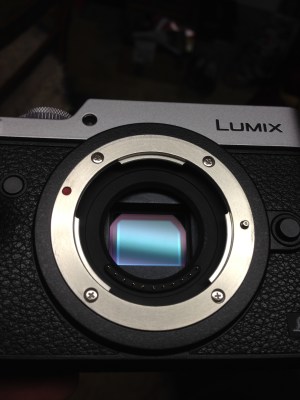
I have been relatively successful over the last few years due to a pathological obsession with how I change the lens (ALWAYS facing downwards) and also because the GX1 and GX8 have automatic sensor cleaning on startup so generally will shake off any dust themselves. However, as is the norm, all good things must come to an end, or the honeymoon period was over, or some such other relevant idiom applied…
160224_GX8sensor


I first noticed an “artifact” as it is called, a few weeks back and assumed it was dust or, hopefully not, a scratch on the lens. This was easily disproved by cleaning the lens and then swapping it with another. The artifact was still there indicating something on the sensor. My initial joy at having not damaged a lens was quickly replaced by trepidation though as this meant the sensor needed cleaning.

Having never had to deal with this before this sent me into a bit of a panic, and started off a trail of research on the web to find out what to do next.  


Next step, a cup of tea and a few quiet (and ultimately frustrating) hours on the laptop. Between google, youtube, discussion boards on dpreview, fineartamerica, and other blogs I learned only one definitive thing, namely:

There is absolutely, definitively, no agreed way to clean a camera sensor “properly”. Period. For every expert that says you should do it one way there is another opining why you should not. The information is almost as useless as arguing the merits of Nikon vs. Canon, or DSLR vs m4/3 format.

There is not even agreement whether this should be done by an individual or a professional. Some (usually camera stores) say to send it to a camera store, others say return it to the manufacturer, others complain that the manufacturers make it worse. Some say it’s easy and others, even professionals, seem scared to do the job.

In fact, the only thing that does seem to garner consensus is the first part of the cleaning process, as outlined here:

  1. Confirm that the sensor is contaminated. This is done by taking a shot of a neutral object at the smallest aperture available, with the lens defocused (use manual focus). Most like to say f/22 but the lens I had on only stopped down to f/16 but was still good enough to see.  For a neutral object I used the cloudless sky as it was available that day!
  2. Use a hand air blower, such as the Giotto Rocket to clean dust off the camera body and lens. DO NOT use compressed air as it contains propellants that can contaminate the optics
  3. Expose the sensor (remove lens and lock up mirror for a DSLR, or simply remove the lens on a mirrorless ILC.)
  4. With the sensor facing downwards blow air over the sensor to dislodge particles and let gravity take them away. DO NOT touch the sensor!
  5. Re-check your sensor by repeating step 1.
  6. If you are lucky then the artifact is gone and congratulations to you on a job well done!

For me though, this was not the case, so over to stage 2 cleaning, as I shall call it, and this is where it gets interesting, and confusing, very quickly.

Several photographers state you should start with a statically charged brush such as the VisibleDust Arctic Butterfly and, if that doesn’t work, move on to dry swabbing and then wet swabbing with a solvent. Others state that dry cleaning is wrong as this could scratch the sensor. Yet others preach that chemicals should not be used but rather your breath or a light steam from holding the camera over a cup of warm water!  Some say use proprietary swabs and cleaners such as Eclipse or VDust, others say use simple lens cleaning fluid, or a highly volatile organic such as methanol and swabs made of Pec Pads. The possibilities go on and on and on, each one with its evangelizing defender expounding how they have “done this for years successfully”.

The only take home message that I could really get is that should be possible to clean the sensor using a variety of methods as long as you are careful and methodical, are scrupulously clean, and do not apply too much pressure to the sensor surface when using some form of lint-free applicator!

So, like everyone else who simply uses their own experiences, I will share mine, to date:

I had begrudgingly purchased a kit from Amazon, specific to my m4/3 sensor size and I was amazed at the cost of four lint-free swabs on sticks and a tiny bottle of solvent. It really it quite staggering how this price is maintained in a free market economy. I guess we photographers are saps for this type of thing!

I followed the sparse pictorial instruction, added solvent to the pad and then attempted to wipe the sensor from left to right, hitting my first snag. Although the kit was labelled as being specifically for micro four third sensors the swab was too wide! So, with solvent rapidly evaporating I do the only thing I could do and wipe the sensor from top from top to bottom. Using my handy illuminated head magnifier (see, I knew this would be handy one day!) I could see that the mark had not been removed from the sensor. Drat! So I repeat the process with a new swab with the same result. That means I have used half my swabs and not achieved anything…

… so ends Part 1 of this saga as I consider what else to do. 😦

~Richard

* Of course for the pedants out there we’re not actually cleaning the sensor in reality, but the anti-alias layer that covers it, but what the heck, it’s all the same in the end as it degrades the image


Blog at WordPress.com.

Up ↑

MrReid.org

Stuff that interests Mr Reid, a physicist and teacher

From 1 Blogger 2 Another

Sharing Great Blog Posts

Journeys Through Pre-World War 3 Britain

Travelling the overcast isles

cancer killing recipe

Inspiration for meeting life's challenges.

the poet's billow

a resource for moving poetry

Lordess

Welcome to my world.

Rustic Rumination

Mind over matter

Stephen Liddell

Musings on a mad world

thisisyouth

Travel. Climbing. Characters. True stories, well told.

OPOD blog

Adventuring the globe whilst based in the beautiful PNW, with a focus on fitness & adventure travel, conservation and a healthy balanced lifestyle. All with my beautiful partner in crime, Stephanie!

Fictionspawn

Games, Illustrations and Short Stories

2Richards, Inc.

Success By Design

Sauce Box

Never get lost in the Sauce

Jim Kayalar Photography

Photo Book Store

DADDYSCUISINE

Happy Eating

in cahoots with muddy boots

Cooking, gardening, traveling and photographing around the globe

P e d r o L

storytelling the world

The New Renaissance Mindset

Perspectives on Lifelong Learning, Education, & The Arts