52 week Challenge: week 10

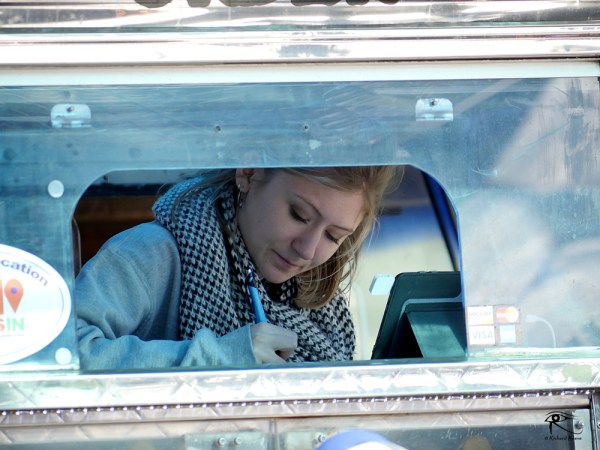
Week 10: Portrait: Environmental – Show a subject in their natural habitat. Their place of work or hobby is a great start. Tell their story with the environment.

I found this to be the toughest assignment so far. I wanted to push my comfort zone in getting out with camera; perhaps creating some street photography. The difficulty for me came with the concept of taking this as a true portrait. I sort of misread the brief a little but I still feel that this shot does meet it as it shows this young lady in the middle of her job writing down a food order for the cook in the food truck. Our only communication was through the little Plexiglas window, which seemed like an obvious frame for the shot.

160308_FastFood

~Richard

Happy Mother’s Day (UK)

Today is Mothering Sunday in the UK. Although we Brits also refer to it as “Mother’s Day” it has a different origin to its namesake celebrated in the US.

Mothering Sunday has origins from a historical religious holiday associated with encouraging people (as in servants, largely) to go back to their “mother churches” on the 4th Sunday in Lent. The fact they also visited their mother’s was probably just taking advantage of having a rare day off from their toils and also because their parents were most likely to live near the original church since, years ago, people didn’t generally travel so far. Over the years, as Britain has become more secular, the original meaning seems to have been largely lost.

Mother’s Day in the US, on the other hand, was first celebrated in 1908 by a lady called Anne Jarvis who held a memorial to her mother Ann Reeves Jarvis, if Wikipedia is to believed, and occurs on the second Sunday of May. It appears to have no particular religious connotations.

Anyhow,  being of British origin, my children helped to celebrate today by accompanying my wife and I to a nice brunch and walk through the local horticultural gardens. I had my small camera with me and so was able to get a few nice uplifting floral shots to share.

160306_SpringFlowers

160306_Tulips

160306_WhiteOrchids

So, to all you mums out there, in the UK and elsewhere – Happy Mothering Sunday!

~Richard

52 week Challenge: week 9

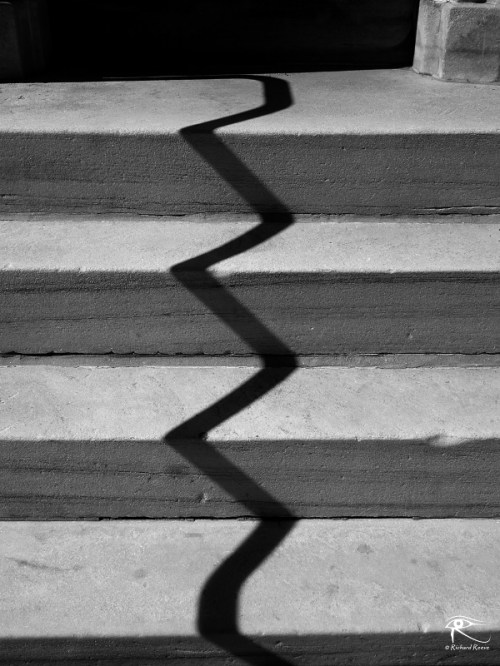
Week 9: Artistic: Shadows – The opposite of light is dark, the absence of light is shadow. Interpret this into a masterpiece.

This was quite an interesting assignment and opened up a lot of possibilities. The one constraint I set myself was that I was only going to use natural light, so no flash or lamps to create shadows that weren’t natural.

I had a trip to Philadelphia, and  in the end settled with a fairly classic abstract taken on the steps of the terrace on Liacouras Walk in Temple University. I converted it to a black and white image as I think it works better for contrasting the zigzag lines onto the grey stone steps.

160301_ShadowTempleSteps

However, last night just as I had returned home from work I caught sight of the shadows cast from a couple of our German Erzgebirge ornaments being cast by the final rays of the setting sun through the window. These are delightful little wooden sun and moon characters and I thought their shadows were lovely, as well as relevant to the time of day.

160301_ShadowSunMoon

In this case I left the image as full color as I think the dark wooden background of the shelf makes the shadows seem warmer, as it partially reflects the sun into a blown out highlight.

~Richard

My Boy Scout Camera Bag

It is amazing what photographic kit you can actually fit into a small camera bag that can be attached to your belt, or easily hand held.  To be more specific, I am describing my 3-year old Case Logic DCB-304 Camera Case that measures a reasonable 7.5” x 7.5” x 5” (19cm x 19cm x 13cm) when packed.

The major reason I took up the micro 4/3 mirrorless camera format in the first place was due to its compact size compared to DSLRs. By careful packing of this little bag I think I have proved my point and was able to easily carry all the equipment I needed for a hike along a river trail and a trip to the ski slopes this afternoon.

I found it a convenient way to carry the following:

Panasonic LUMIX DMC-GX8

Panasonic Lumix G H-H020AK 20mm F/1.7

Panasonic 45-200mm f/4.0-5.6

Battery charger and two batteries

Several SD cards

and either an iPhone or a fun pancake lens such as the Olympus 15mm f/8.0 Body Cap Lens

If you don’t believe me see the images taken in my “studio” (the basement ironing board!) when I got back from the trip:

160228_Bag1
kit and caboodle
160228_Bag2
lens in first
160228_Bag3
GX8 on top facing the “hinge”

Simply (I so love that word!) flip the hood back over the big telephoto lens and pack it horizontally in the base of the bag, then cover with a lens cloth and add the GX8 horizontally too, as shown.

Next put the charger in one side pocket, and two spare batteries in the other side pocket.

The SD cards fit easily in the inside pocket in the flap and the little front inside expandable compartment will hold either your phone (will fit an iPhone 6) or the Oly body cap lens for a bit of fun.

OK, it’s not exactly a survival kit, but it’s a pretty good compact set-up for a scouting photographer and  I think Akela would be happy enough with my efforts.

~Richard

Making Sense of Sensor Cleaning – Part 1

Making Sense of Sensor* Cleaning – Part 1

Disclaimer: I am recounting only my experience and not endorsing any form of sensor cleaning through this posting. You take full responsibility for any actions you take as a result of reading my ramblings…

One of the great things about using ILC cameras, like my trusty Panasonic micro four-thirds, and also DSLRs, is the ability to swap lenses for different situations; a prime lens for street work and landscapes, or a telephoto for wildlife perhaps. This comes at a price though; namely that there is always a risk in getting the sensitive camera sensor contaminated with dust, fibers, and other extraneous crud when changing lenses.

I have been relatively successful over the last few years due to a pathological obsession with how I change the lens (ALWAYS facing downwards) and also because the GX1 and GX8 have automatic sensor cleaning on startup so generally will shake off any dust themselves. However, as is the norm, all good things must come to an end, or the honeymoon period was over, or some such other relevant idiom applied…
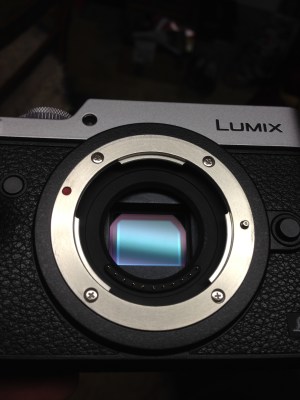
160224_GX8sensor


I first noticed an “artifact” as it is called, a few weeks back and assumed it was dust or, hopefully not, a scratch on the lens. This was easily disproved by cleaning the lens and then swapping it with another. The artifact was still there indicating something on the sensor. My initial joy at having not damaged a lens was quickly replaced by trepidation though as this meant the sensor needed cleaning.

Having never had to deal with this before this sent me into a bit of a panic, and started off a trail of research on the web to find out what to do next.  


Next step, a cup of tea and a few quiet (and ultimately frustrating) hours on the laptop. Between google, youtube, discussion boards on dpreview, fineartamerica, and other blogs I learned only one definitive thing, namely:

There is absolutely, definitively, no agreed way to clean a camera sensor “properly”. Period. For every expert that says you should do it one way there is another opining why you should not. The information is almost as useless as arguing the merits of Nikon vs. Canon, or DSLR vs m4/3 format.

There is not even agreement whether this should be done by an individual or a professional. Some (usually camera stores) say to send it to a camera store, others say return it to the manufacturer, others complain that the manufacturers make it worse. Some say it’s easy and others, even professionals, seem scared to do the job.

In fact, the only thing that does seem to garner consensus is the first part of the cleaning process, as outlined here:

  1. Confirm that the sensor is contaminated. This is done by taking a shot of a neutral object at the smallest aperture available, with the lens defocused (use manual focus). Most like to say f/22 but the lens I had on only stopped down to f/16 but was still good enough to see.  For a neutral object I used the cloudless sky as it was available that day!
  2. Use a hand air blower, such as the Giotto Rocket to clean dust off the camera body and lens. DO NOT use compressed air as it contains propellants that can contaminate the optics
  3. Expose the sensor (remove lens and lock up mirror for a DSLR, or simply remove the lens on a mirrorless ILC.)
  4. With the sensor facing downwards blow air over the sensor to dislodge particles and let gravity take them away. DO NOT touch the sensor!
  5. Re-check your sensor by repeating step 1.
  6. If you are lucky then the artifact is gone and congratulations to you on a job well done!

For me though, this was not the case, so over to stage 2 cleaning, as I shall call it, and this is where it gets interesting, and confusing, very quickly.

Several photographers state you should start with a statically charged brush such as the VisibleDust Arctic Butterfly and, if that doesn’t work, move on to dry swabbing and then wet swabbing with a solvent. Others state that dry cleaning is wrong as this could scratch the sensor. Yet others preach that chemicals should not be used but rather your breath or a light steam from holding the camera over a cup of warm water!  Some say use proprietary swabs and cleaners such as Eclipse or VDust, others say use simple lens cleaning fluid, or a highly volatile organic such as methanol and swabs made of Pec Pads. The possibilities go on and on and on, each one with its evangelizing defender expounding how they have “done this for years successfully”.

The only take home message that I could really get is that should be possible to clean the sensor using a variety of methods as long as you are careful and methodical, are scrupulously clean, and do not apply too much pressure to the sensor surface when using some form of lint-free applicator!

So, like everyone else who simply uses their own experiences, I will share mine, to date:

I had begrudgingly purchased a kit from Amazon, specific to my m4/3 sensor size and I was amazed at the cost of four lint-free swabs on sticks and a tiny bottle of solvent. It really it quite staggering how this price is maintained in a free market economy. I guess we photographers are saps for this type of thing!

I followed the sparse pictorial instruction, added solvent to the pad and then attempted to wipe the sensor from left to right, hitting my first snag. Although the kit was labelled as being specifically for micro four third sensors the swab was too wide! So, with solvent rapidly evaporating I do the only thing I could do and wipe the sensor from top from top to bottom. Using my handy illuminated head magnifier (see, I knew this would be handy one day!) I could see that the mark had not been removed from the sensor. Drat! So I repeat the process with a new swab with the same result. That means I have used half my swabs and not achieved anything…

… so ends Part 1 of this saga as I consider what else to do. 😦

~Richard

* Of course for the pedants out there we’re not actually cleaning the sensor in reality, but the anti-alias layer that covers it, but what the heck, it’s all the same in the end as it degrades the image

52 Week Challenge: Week 8

Week 8: Landscape: Wide Angle/Panorama – This is a great opportunity to explore panorama stitching and create a wide sweeping landscape.

Today was unseasonably warm, rising to 61°F (16°C) in the afternoon, so I took the opportunity after my Saturday taxi driving for the entire family over several hours to visit a local nature preserve while there was still some sunlight left and before the next round of vehicular collections was due.

I know the experts all tell us to use a tripod for panorama shots but, to be honest, I was in a bit of a rush, and I know I have pretty steady hands,so I initially tried using the in-camera panorama mode of my Panasonic GX8 to produce this quick image:

P1020271

For everyday use I think it does a good job. The camera uses rapid fire mode and you simply pan it left to right. The only downside is that it produces an image only 1920px tall, so it’s a bit limited for printing.

So, over to the manual approach and the use of stitching software, as requested in this week’s challenge. I have used the free  Hugin image stitcher before which is very capable and allow for a lot of fine tuning. However, this time I used the much more intuitive (and free) Microsoft Image Composite Editor (ICE).

So the process is to take a series of shots when panning, ensuring that at least 30% of the image overlaps between frames. This gives the software a lot of ability to match elements in the images and so map them properly. By using the camera vertically I was able to get a panorama 5002px in height and 17695px wide. Big enough to do a lot with! The reason is wasn’t full sensor height was because I hand held and wasn’t perfect in holding it level throughout the series, so ICE had to crop it to get a straight edge. It’s all easy to do though.

I made several composites but in the end I chose this one, simply because I liked the texture of the corn (maize) field in the foreground:

P1020286_stitchEDIT

~Richard

#dogwood52 #dogwoodweek8

52 week challenge: week 7

Week 7: Portrait: Faceless – Tell someone’s story without showing their face.

Ice Queen No More

The night was bitterly cold. So cold, in fact, that it was too painful for her to draw a deep breath. She waited for him inside the building and tried to peer out through the frost covered window. At last she spied him hurrying towards the door. She smiled. Soon they would both be warm.

160215_IceQueen

~Richard

#dogwood52 #dogwoodweek7

Latest Cameras from Nixon and Conan

Amid great fanfare the two flagship camera manufacturers today launched their latest and greatest DSLR products to an eagerly awaiting crowd of photographers at KameraTek 2016 in Berlin, Germany. The Conan CIII-p0 and the Nixon RII-d2 are similarly priced and are clearly aimed at the aspiring professional photographer, as well as those amateurs with bags of cash, who must have the latest gear. But how do they shape up in the field? Well, few have been able to get hold of the models yet as both manufacturers have kept them under tighter wraps than the details of a Donald Trump political plan, but we are able to report that novel technology is used in both models as we had pre-release models.

The Conan boasts a staggering new focus system, ADHD, with 1024 focal points being monitored to ensure that it’s almost impossible to get a blurry shot. Meanwhile Nixon has finally been able to launch its new OCD image stabilization system after more than 2 years in beta-testing.  Interestingly, both models now appear to follow the same algorithms of Sunny’s latest WTF image capture engine which users of the iPharce 6 may find similar to Abble’s Live Photo feature, that became so popular in the last year.

Not to be outdone by the big two, Olympix  also announced their latest m43 flagship model the Olympix OMG, which packs an astounding 26.8MP into this crop sensor, a 30 fps continuous burst mode and a new array of mouthwatering lenses to fit its rangefinder style body. Interestingly, although they have adopted a new RoFL mount system, it remains compatible with the old LoL system too, which is great news for those who committed to the much older technology introduced way back in 2015.

Cameras 9 ©2016, Richard Reeve

All these advancements of course will make very little difference to any photographer’s skill at being able to compose an artful composition, but then that isn’t part of the design. We consumers have an insatiable appetite for the latest changes, however incremental, and readily gobble them up on  a six-monthly schedule in the never-ending quest for the latest gear. And the manufacturers are simply feeding the beast.

Carry on clicking…

~Richard

52 week challenge: week 6

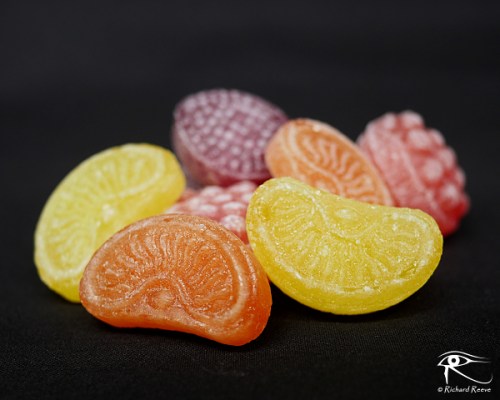
Week 6: Artistic: Candy – Your artistic interpretation this week should be inspired by something sweet. A great chance to play with macro photography.

This one was relatively easy for me, as we have a house full of candy at the moment, an excess from xmas and some more recent additions for Easter. Or rather, since “candy” isn’t a term I would normally use, we have lots of “sweets” in the house, to use proper British vernacular!

The ones that I chose are known in the US as “fruit candies”, but as kids we would have called them “boiled sweets” and they were a staple available from any elderly relative who, back in my childhood days, always seems to have a variant of these on hand in a paper bag in case of getting a dry throat or a cough. Odd behavior perhaps, but I’m just telling it like it was.

I was going to use a zoom and some of my macro tubes to experiment but in the end I decided to stick with f/1.7-20mm as before and set this up in my “studio” by placing a black cloth over a chair balanced on the ironing board under the shop LED lights in the basement! I couldn’t be bothered to dig out a tripod from the trunk of the car so I took the shot hand held and used manual focus to get as close as the lens would allow me.

Sweet and Fruity

I’m pleased with the result but let me know what you think.

~Richard

#dogwood52 #dogwoodweek6

Blog at WordPress.com.

Up ↑

MrReid.org

Stuff that interests Mr Reid, a physicist and teacher

From 1 Blogger 2 Another

Sharing Great Blog Posts

Journeys Through Pre-World War 3 Britain

Travelling the overcast isles

cancer killing recipe

Inspiration for meeting life's challenges.

the poet's billow

a resource for moving poetry

Lordess

Welcome to my world.

Rustic Rumination

Mind over matter

Stephen Liddell

Musings on a mad world

thisisyouth

Travel. Climbing. Characters. True stories, well told.

OPOD blog

Adventuring the globe whilst based in the beautiful PNW, with a focus on fitness & adventure travel, conservation and a healthy balanced lifestyle. All with my beautiful partner in crime, Stephanie!

Fictionspawn

Games, Illustrations and Short Stories

2Richards, Inc.

Success By Design

Sauce Box

Never get lost in the Sauce

Jim Kayalar Photography

Photo Book Store

DADDYSCUISINE

Happy Eating

in cahoots with muddy boots

Cooking, gardening, traveling and photographing around the globe

P e d r o L

storytelling the world

The New Renaissance Mindset

Perspectives on Lifelong Learning, Education, & The Arts