52 week challenge: week 16

WEEK 16: Portrait: Movement – Most portraits are stationary, so this week explore adding some movement. Dancing, twirling, or even hair flips.

Lots of choices this week – skateboarding, bicycling, etc. In the end I went for more localized movement – portrait of a drummer jamming in the basement…

160419_BasementDrummer

~Richard

Spring has finally sprung… the tulips are here

It has been a month since we “sprung forward” with the annual clock moving, and we have since had some odd weather in Pennsylvania, fluctuating between a nice 70°F (21°C) all the way down to 21°F (-6°C) depending on the day. We even had one full day of snow last weekend!

All very frustrating, but all part of the change of Seasons.

Well, today was finally nice enough for me to get outside into the garden and start work tidying things up, cutting the lawn, building up the veggie plots and generally appreciating the outdoors life. And what’s more, over the last few days the tulips have finally come into bloom.

160416_Tulip
Happy Spring!

~Richard   

52-week Challenge: week 15

WEEK 15: Artistic: Metal – Cold, hard steel. Shiny Aluminum. Or even rusted and broken down. Find your inspiration in metal this week.


Metal, one of my favorite subjects for artistic photography. I love rusty old metal, shiny metal, industrial, forged, ironworks, you name it. I have even tried my hand at blacksmithing only a couple of years back and would love to have my own forge. Heck, even one of my favorite songs of my youth is about it.

I already have a reasonable collection of suitably themed images available but, keeping true to the challenge I decided to try something a little different. Given that I spend 8 hours a day in an office environment I thought I would choose an everyday object from my desk and see what I could do with it using my handy iPhone5.

160411_Stapler

~Richard

52-week Challenge: week 14


WEEK 14: Landscape: Zoomed in – Most landscapes are wide sweeping images. Try an alternative and zoom in instead.


I admit that this seemed counter-intuitive to me. I always associate landscapes with sweeping vistas, and therefore using a relatively wide lens like my 20mm (that’s 40mm equivalent on a 35mm frame). But the assignment seemed clear so I attached my biggest glass, the 200mm  (that’s a huge 400mm equivalent on a 35mm DSLR) and zoomed in on a woodland landscape near my home.

In order to make it more interesting I captured a little of the Spring grass and some spiky overwintering plants in the foreground, with the wooded landscaped valley behind.

160405_LandscapeZoom

~Richard

The prime numbers don’t add up, at least not initially

There seems to be few things that some photographers like to do more than argue the relative merits of their opinions on equipment; whether it be the age-old Nikon vs Canon battle (see here for my parody), or whether DSLRs are better than mirrorless cameras, what is the best crop-sensor size or, one of my favorites: the time-honored argument of prime lenses vs. zoom lenses.

Thus, when starry-eyed, enthusiastic newcomers graduate to cameras with interchangeable lenses (ILCs) from their point-and-shoot kits (P&S), as we pompous photogs like to call them, they are barraged by a “wealth” of conflicting gibberish about the latest must have lens in order to take their photography “to the next level.” In fact, a quick look at my twitter and pinterest feeds show that around 10% of the traffic crossing my path concerns this crap at the moment.

Well, not to be outdone I’m going to add my opinion to what I view as a sea of consumerism, shrouded in pointless perfectionism, specifically focusing (!) on the prime vs zoom lens argument. So, here goes:

For the uninitiated the logic goes like this – camera lenses are a complex set of individual glass elements which fit together to allow image focus at a certain distance. Prime lenses have a fixed focal length whereas zoom lenses, by very definition, do not. Zoom lenses give you much more flexibility on composing your shot but this comes at some cost to image quality. In order to achieve this flexibility the zoom lenses must have more elements and therefore be more complicated. It also is not designed to be “perfect” at one focal length and therefore has to compromise throughout the focal range. This compromise is what drives many photographers nuts, mainly because they are obsessed with the concept of obtaining the ever-elusive “tack sharp” image.

To be brutally honest the there is one huge advantage that prime lenses do have over zoom – the availability of much wider apertures for the same focal length, but please read on…

My view is that unless you are planning on producing a print that it larger than, say 40” (100cm) on one side, or have a penchant for specialist photography such as macro, or starlight, or you want a compact 50mm (that’s a 25mm for us m4/3 users!) for street work, then generally speaking, swapping a zoom lens for a much more expensive prime lens isn’t really worth it, at least not until you discover your niche area of photography (if you ever do). In fact, given that the vast majority (>99%) of images are never, ever printed at any size, I’ll put it another way –  don’t rush out and spend your cash on expensive prime lenses, until you have worked out if you have a real need for one.   

As a budding photographer, surrounded by a maelstrom of magazines and blogs that are often nothing more than pages of advertisements,  what does matter is honing your skill as a photographer in understanding the relationship between aperture, shutter speed and (that so-antiquated term) ISO. That, and the ability to actually focus and knowing how to compose a shot to tell the story you want to convey! It is for this reason the good old zoom lens is a great lens to have as it allows you to experiment, and experimentation is the best way of learning any new skill.

In my experience the kit lenses (usually zoom) that are provided with an ILC have been perfectly adequate for 95% of the photographs I take.

And if you think this is all bull, then here’s a sobering thought – I have sold several large prints to buyers, some up to 27” x 36” (68 cm x 91 cm) taken with an iPhone 5, so where does that leave the “you must invest in an expensive prime lens to take a good photograph” argument?

~Richard

52-week Challenge: week 13

WEEK 13: Portrait: High Key – Expose to the right and create a light, airy high key portrait.

Oops, my bad. For some reason I was more hung up on trying to figure out the concept of “high key photography” versus “high key lighting” and simply exposing to the right (ETTR) than actually looking at the brief in sufficient detail. Anyhow, as usual there’s a lot of highfalutin crap written about high key photography, and I don’t have the interest or time to argue. To me it simply means light tones and no shadows.

I have produced a high key image but not a portrait (of a person). And now the weekend is over my models are no longer available! I will have to try again…

160328_TulipHiKey


~ Richard

Lasagna’s Law, Buses and Photography

In 1970, American physician and clinical pharmacologist, Louis Lasagna, described the phenomenon that is well known to those of us who work in the field of clinical research: “The incidence of patient availability sharply decreases when a clinical trial begins and returns to its original level as soon as the trial is completed.”  In other words, when discussing with physicians to see if a clinical study with a new drug or device is feasible, it’s amazing how many suitable patients “disappear” from the face of the earth as soon a study starts, thus making the study slower, more expensive, and overall more difficult than had been “promised.”  Over the years, this became known as “Lasagna’s Law (of patient recruitment)

Similar phenomena, however, are not isolated to research.  For example, users of public transport (at least in Britain) are familiar with the oft-quoted idiom:  “you wait for a bus for a longer than you should have to and then three come along at once.” *

So what is going on here?

My conjecture is that much like the phenomenon of pareidolia, this is linked as much to human  perception as to anything based in reality: the physicians probably think they see more suitable patients than they do as they are concentrating on a particular set of criteria, but probably in a too generalized manner (if that makes sense).

I bring this up because in order to complete my week 12 photography challenge I finally settled upon the idea of photographing a yellow school bus, as I blogged yesterday. How many of these do we see every day? How often do I wait for the flashing red lights and pop out stop signs? I would have estimated at least a dozen a day for the first question and at least once a day for the second. But when I want to see them, what happens? I start to question my reasoning, that’s what!

This seemingly easy, self-inflicted assignment suddenly became a challenge. A man with camera pitted against fate. The buses all seemed to me to have left the streets or only appeared briefly when my camera wasn’t handy, sneaking behind other vehicles, billboards, road signs and nature. I decided that I don’t want to appear as some weird stalker, so I wasn’t prepared to hang around the school yard with a camera, so that left me with no option but to treat this like a pseudo-wildlife shoot.

I managed to snatch some shots from the parking lot at the local Wawa store, but for some reason I felt a bit like a private investigator digging up dirt – not a nice feeling. And I got glared at by one car driver as she drove into the lot.

160325_SchoolBus01

In the end, I changed the scope of my assignment. When driving to work that final morning (I like to keep to the weekly timing) I decided to visit the equivalent of the wildlife “watering hole” in the savanna, namely, the local bus lot, to capture these elusive beasts.  So,  at lunchtime I snatched 20 minutes to drive out to one which is nearby and to sheepishly ask the guy in charge if I could photograph some buses.  As it happens, there was no-one in what appeared to be the gate house so I just stood outside and clicked away.

Job done, at last!

So, what, if anything, is the lesson here? Well, although it ended well enough, albeit under pressure, I should probably think more about setting a realistic goal in the future. And to that end, I think I will finish with the old British Army adage of the 7Ps, which always holds true, in my experience, and should be well heeded by us all.

l leave you to look up, dear reader 😉

~ Richard

* As an aside, there does appear to be a totally different rationale for this one, though – it’s called “platooning” apparently.

52-week Challenge: week 12

WEEK 12: Artistic: Transportation – Our world is one defined by how we get around. Literal or interpretative, find inspiration in transportation.

I had too many ideas for this one; cars, trains, bicycles, buses, perhaps even an Amish carriage, if I were to travel west a few dozen miles.  I mean, how can so much choice be a problem, right?

Well, it can because the issue then becomes one of creative overload, at least in my case. Yes, I need to focus (pun intended) on what I actually want to achieve with this assignment.

So, a day or two to think and then here we go:

Idea 1: Panning cars traveling on the highway to give a blurred background. It didn’t happen.

Idea 2: An arty shot of an AMTRAK train or the SEPTA regional railway, maybe in black and white. It didn’t happen.  

Idea 3: A bustling street scene in the center of town, or a commuter ride showing traffic congestion. It didn’t happen.

Idea 4: Cyclists – there’s always several of these guys on the back roads at the weekend. That one didn’t even start!

Grr, what’s going on?

Then, on the Monday morning drive to work, an epiphany: the American school bus – it’s so obvious!

As an immigrant from England the yellow school bus is as much an internationally known icon of US society as the red double-decker bus is quintessentially British. It instantly identifies any scene as being American. I would venture more so even than a slice of mom’s apple pie cooling on the window sill…

… and I know where they park a lot of them 🙂

160324-SchoolBusMirror

Oh, and there’s a backstory to this as well – I will share that on tomorrow’s post

~Richard

Making Sense of Sensor Cleaning – Part 2 (or the benefit of camera insurance)

Making Sense of Sensor Cleaning – Part 2 (or the benefit of camera insurance)

Disclaimer: I am recounting only my experience and not endorsing any form of sensor cleaning through this posting. You take full responsibility for any actions you take as a result of reading my ramblings…

This is a continuation of my previous post on sensor cleaning from three weeks ago. I will start off by saying it didn’t go the way I expected, but in the end turned out as a pleasant surprise.
As mentioned in the previous post I had purchased a VisibleDust m4/3 sensor cleaning kit and used it to try and clean the blemish on the sensor of my GX8 which was causing all sorts of problems when the lens was stopped down. Although this kit appears to be adequate for general dust removal, the blemish  I had seemed very stubborn. I used all the swabs and solution in the kit and had a beautifully clean sensor – apart from the bit I wanted to clean! So, I am now thinking it may be sensor damage, although it doesn’t look like a scratch under a magnifier. My last-ditch  attempt was to think big and go the route of using Pec Pads and Eclipse solution, that someone on fineartamerica had suggested,  so that I could try more than four attempts at sensor cleaning before running out of pads or solution again! The new products duly arrived from Amazon and I carefully removed a 4” x 4” Pec Pad, cut it into a strip and then folded it over the end of one of the plastic swabs from the earlier kit (having first removed the original pad, obviously) and fastened it with a piece of tape to the handle. I repeated the cleaning process with the new Eclipse liquid and it did a great job, but still couldn’t budge the mark! In desperation I tried this 5 or 6 more times and it seemed to be having no impact whatsoever. The mark didn’t get any smaller so I finally resigned myself to having to send the camera for repair.

As I was mumbling to myself about the likely cost of this and trying to figure out how the sensor got damaged I suddenly recalled that I took out  Squaretrade accidental damage insurance when I bought the camera 6 months ago. Well done great pre-senile memory! Ironically, this is not something I would normally do, so perhaps it’s not surprising I had “forgotten”.

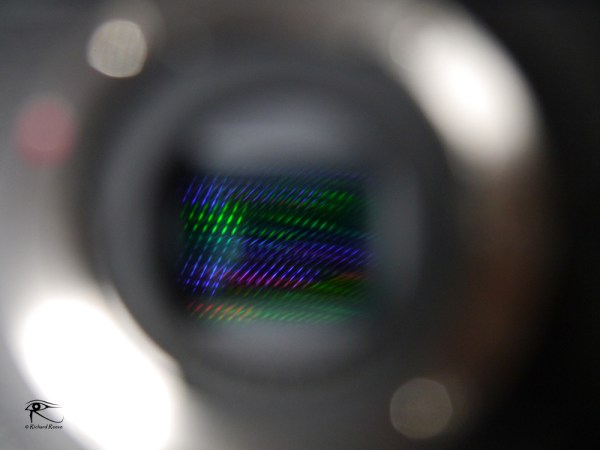
160314_Sensor
You cannot see the blemish, but the refraction is pretty!

Amazingly I found the details buried in my gmail, completed a claim form online and the same day I received confirmation that the claim is good and a return label. Over the weekend I found a suitable box and packed up my beloved camera with charger and battery and sent it off. I didn’t expect to hear anything for several weeks and then thought I’d be in for a fight. So, imagine my surprise when I returned from work last night, only 5 days after shipping it back, to find a brand new GX8 sent to me straight from B&H Cameras!

Now I am a very happy photog again 🙂

So, what are the lessons I have learned from this rambling episode?

  1. Sensor cleaning is nothing to be scared of, as long as you are methodical, careful,  and clean.
  2. Pec Pads and Eclipse solution work as well or better than a cleaning kit and will do a great job for general cleaning a sensor of minor dust at a lower cost. (They can also be used on lenses too)
  3. SquareTrade insurance is a great value product for your camera, especially if you buy it in conjunction with your camera purchase through Amazon (which makes it about half the cost of their own website).


~Richard

52-week Challenge: week 11

WEEK 11: Landscape: Reflection – Find a way to show your landscape/natural beauty in reflection. The mirror world revealed.

I had contemplated this assignment ahead of time and even went to the dollar store to get a mirror for inspiration. Nah, I thought that would be too cheesy. Then I considered perhaps a reflection of the countryside in a pair of sunglasses, but that would require a willing model! My next brainwave came when one of my daughters decided she needed a ride to the shopping mall – use the car window to get a reflection of an urban landscape – brilliant!

Of course, things never work out quite that way, do they? Rather than dropping off my daughter and her friend I was told I could pick them up instead. This is always the worst of the two standard unpaid “Uber” roles for a parent as there’s no definitive meeting time or place. Ho hum, thinks I, I can still do this as I’ll get there a little early and take time to position the car for its job as photographic canvas.

I hadn’t anticipated how full the parking lot would be, nor the rain.

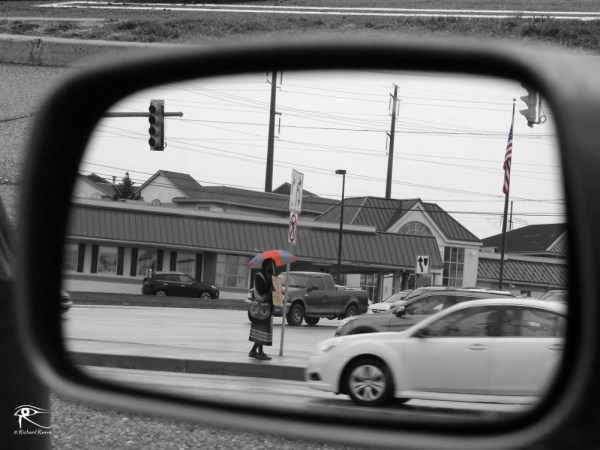
As I was driving around searching for a place I thought to reverse park in one space at the edge of the lot. This way I would be able to use my driving mirrors to get a shot across the road and modify my original idea.

As I did so, I saw the reflection of a this guy across the street begging money from cars at the stop signal. The light was fading fast and he was there only for a few minutes, presumably after a long day. The irony of the red and blue umbrella and the stars and stripes hanging limply nearby was not lost on me – a reflection of humanity in the world’s richest nation, perhaps?

160314_Reflection

~Richard

Blog at WordPress.com.

Up ↑

MrReid.org

Stuff that interests Mr Reid, a physicist and teacher

From 1 Blogger 2 Another

Sharing Great Blog Posts

Journeys Through Pre-World War 3 Britain

Travelling the overcast isles

cancer killing recipe

Inspiration for meeting life's challenges.

the poet's billow

a resource for moving poetry

Lordess

Welcome to my world.

Rustic Rumination

Mind over matter

Stephen Liddell

Musings on a mad world

thisisyouth

Travel. Climbing. Characters. True stories, well told.

OPOD blog

Adventuring the globe whilst based in the beautiful PNW, with a focus on fitness & adventure travel, conservation and a healthy balanced lifestyle. All with my beautiful partner in crime, Stephanie!

Fictionspawn

Games, Illustrations and Short Stories

2Richards, Inc.

Success By Design

Sauce Box

Never get lost in the Sauce

Jim Kayalar Photography

Photo Book Store

DADDYSCUISINE

Happy Eating

in cahoots with muddy boots

Cooking, gardening, traveling and photographing around the globe

P e d r o L

storytelling the world

The New Renaissance Mindset

Perspectives on Lifelong Learning, Education, & The Arts