
As we struggle though another week of heatwave here on the East Coast, and watch the geopolitical storms unfurl around us, I thought I’d clear my mind and reminisce about sitting on Brighton Beach (or rather the pebbles) a few years ago.
Chill out!

Philosophical Photography, Percontation, Prose, Poetry, Parables, Pottery & Politics… Phew!
As we struggle though another week of heatwave here on the East Coast, and watch the geopolitical storms unfurl around us, I thought I’d clear my mind and reminisce about sitting on Brighton Beach (or rather the pebbles) a few years ago.
Chill out!
I have been very busy these last few weeks. Too busy, in fact to pay attention to this blog so I thought I’d cheat this time and ask Microsoft CoPilot AI to help me out by reviewing an image I took of our dog waiting in the sunlight on the top of the stairs of the AirBnB in which we stayed recently.
The resulting prose is interesting, sort of impressive, in a pseudo-philosophical way, and of course totally incorrect. See what you think, and roll your eyes:
Me: “write a blog post about the following image: https://reevephotos.com/featured/patience-richard-reeve.html”
CoPilot:
“Title: “Patience: A Reflection on Time and Stillness”
!Patience
In the quietude of a sun-dappled forest, where time seems to stretch and fold upon itself, we find “Patience.” This captivating photograph by Richard Reeve invites us to pause, breathe, and contemplate the delicate balance between movement and stillness.
The image transports us to a secluded woodland clearing. Shafts of golden light pierce through the canopy, illuminating the moss-covered ground. A gnarled tree stands sentinel, its twisted branches reaching skyward. The air is thick with anticipation, as if the very leaves hold their breath.
What is patience? It is not merely the absence of haste; it is an active surrender to the rhythm of existence. In this tableau, time slows down. The tree’s rings whisper stories of centuries past, and the ferns unfurl their delicate fronds at their own leisure. The sun, too, takes its time to caress each leaf, casting intricate shadows on the forest floor.
As we gaze upon “Patience,” we are reminded of nature’s wisdom. The tree teaches us resilience—the ability to withstand storms and seasons, to bend without breaking. The ferns teach us persistence—the gradual unfurling of potential, even in the darkest corners. And the sunlight, filtered through leaves, teaches us presence—the art of being fully here, now.
In our fast-paced lives, stillness is a rare gift. We rush from task to task, our minds perpetually racing. But here, in this forest glade, we glimpse the beauty of quietude. The tree does not fret about tomorrow; it stands rooted in the present. The ferns do not compare themselves to others; they grow at their own pace. And the sunlight, unburdened by clocks, bathes everything in its gentle glow.
“Patience” invites us to linger. To sit on the fallen log, feel the rough bark against our palms, and listen to the rustle of leaves. It asks us to release our grip on time, to let go of urgency, and to embrace the stillness that surrounds us. Perhaps, in doing so, we discover that patience is not a waiting game—it is a way of being.
So, dear reader, take a moment. Look at the photograph once more. Imagine the cool breeze on your skin, the scent of damp earth, and the whisper of leaves. Let “Patience” be your guide—a silent mentor in the art of living fully, one moment at a time.”

So, what do you think? Are we safe from the inexorable march of the machines for a little bit longer?
I have been learning Spanish for a while using Duolingo, in part to support my travels to Puerto Rico, Spain, and Uruguay. It’s an interesting way to learn vocabulary and set phrases, but on many occasions the examples it uses can be a little bizarre. Presumably this is to make the sentences stand out and stick in the memory.
That being said, over the last few days I have faced several screens which made me question whether Duo the perky owl who fronts the app is perhaps having an existential crisis. I provide my evidence in the order in which they were received over a few days:

The other question on my mind is “who was Pedro?” Does anyone have any suggestions?

We stumbled across this rather well composed street graffiti in Montevideo last winter (their Spring), and its construction of a 20 Peso banknote bearing the image of Juan Zorrilla de San Martín with added musical imagery intrigued me to conduct a little follow up research:
The image is of the poet, Juan Zorrilla de San Martín (1855–1931). However, he was much more than a poet; he was a beacon of Uruguayan identity. His verses celebrated the rugged landscapes, the gaucho spirit, and the resilience of a nation. His epic poem, “Tabaré,” immortalized the indigenous people and their struggles.
I am unsure as to the meaning that the artist wanted to impart to their audience through this juxtaposition, but I offer up the following verse by way of homage to both the poet and the street artist who pasted this to the wall:
In the city’s pulse, where concrete meets sky,
Whispers of poets and rebels never die.
Their ink spills onto walls, a silent plea—
Freedom, justice, love—their legacy.
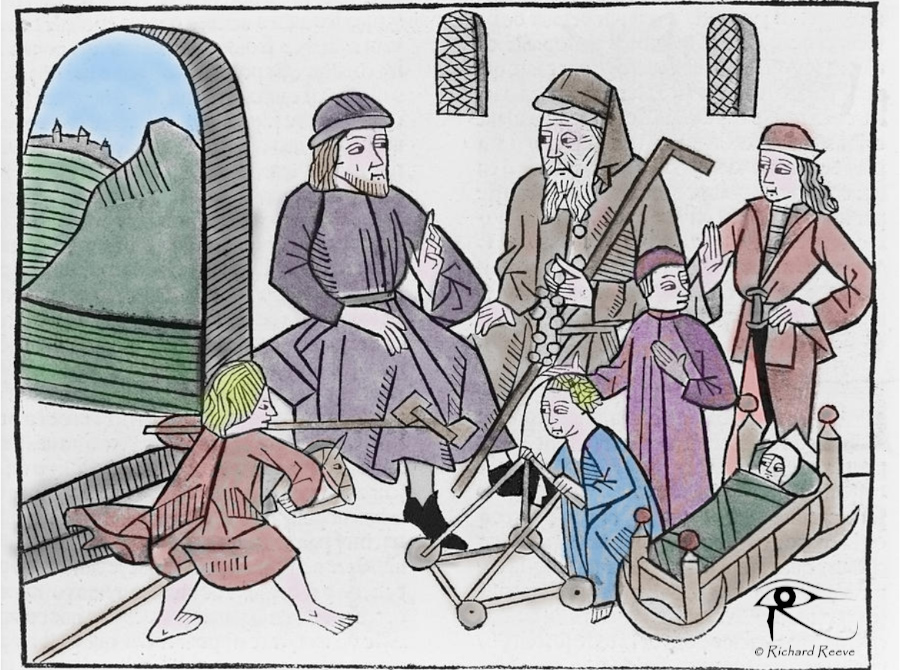
Several years ago, I would while away the late hours on the web looking for old artwork for inspiration, as a learning exercise and also to see if I could rework and give some a new life (if it was not copyrighted). An example of this is a digitally retouched and colored version of a woodcut by Bartholomaeus, Anglicus from 1486 AD.
This wonderful scene illustrates the artist’s perception on the various life stages of man, a subject that would later be depicted in William Shakespeare’s, As You Like It – Act II, Scene VII as the “seven ages of man.”
The original black and white lines of the image are clean and crisp, almost modern in their simplicity but I felt that adding simple coloring to the scene would make it pop a little. What do you think?

OK, I have been really lax with this blog and not written anything for a long, long time, but this is an important message for all and any readers.
This will not be the usual post, but I just wanted to get this out to people, especially following the President’s speech last night which was lackluster at best, and unforgivably misleading, at worst.
COVID-19 is here in the US. It has been spreading within the community for 15 days already, according to CDC.
Unchecked, the infection rate will be exponential, doubling every day or so.
It is more infectious and more fatal than the ‘flu, although it does affect older people much worse than younger people.
Younger people can spread it to older people, and we do not know the extent of the spread in the US yet since the CDC and FDA were woefully slow in closing to use their own test and releasing it too late.
Likely there are tens of thousands of people infected and spreading it already, possibly more.
It is important that people understand the seriousness of this situation.
The following article is a superb analysis of the pandemic:
Please Read This Analysis of the Coronavirus Impact
Please, please read it if you can. It not, or TLDR, then skip to Chart 23 at the and also read the text beneath.
Please take care, practice “social distancing” and #NowWashYourHands
~Richard
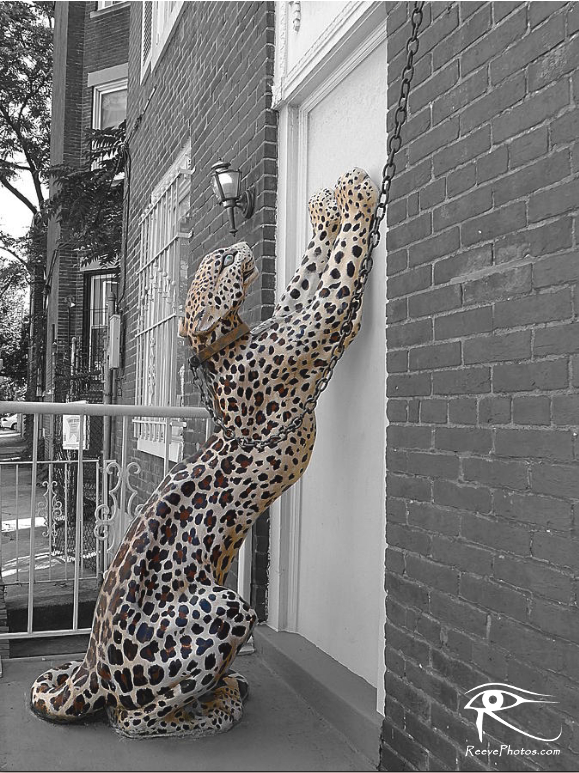
It’s amazing what you can find in the most normal of settings, and unexpectedly. All you have to do is keep your eyes open and actually look at your surroundings. For example, Philadelphia seems to be full of surprises such as this wonderful sculpture of a leopard on South 20th Street and Manning Street near Rittenhouse Square. One story has it that it the building which it is attempting to get into used to be a lingerie store and that this was used as marketing. The store has long gone but the leopard remains.
Nestled on the Tendring peninsula on the east coast of England, and providing seaside entertainment for the masses for over 150 years, the town of Clacton may seem like any other British seaside town. Clacton came to prominence in 1871 when it was founded by Peter Bruff as a seaside resort, largely for Londoners to escape the city. He built the pier, which still stands today, and steamer was the main method of reaching the town until the road and rail system caught up.
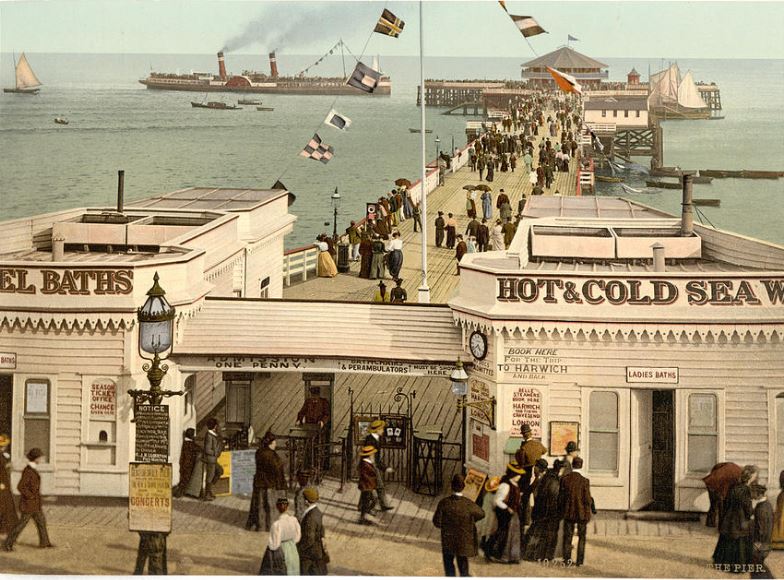

The heyday of the town was really the middle decades of the twentieth century when there was a Butlins Holiday Camp and many hotels and guest houses to entertain the day trippers and summer holiday makers. Then along came cheap flights to more exotic locations and, like so many British resorts, there was a significant downturn in the economy.
Even in the 21st century the town still has a significant number of visitors and people enjoying the sandy beaches, and going on the rides and other amusements on Peter Bruff’s original pier. When we were kids there were dolphins and orcas kept in the swimming pool on the pier, but thankfully that’s gone now.
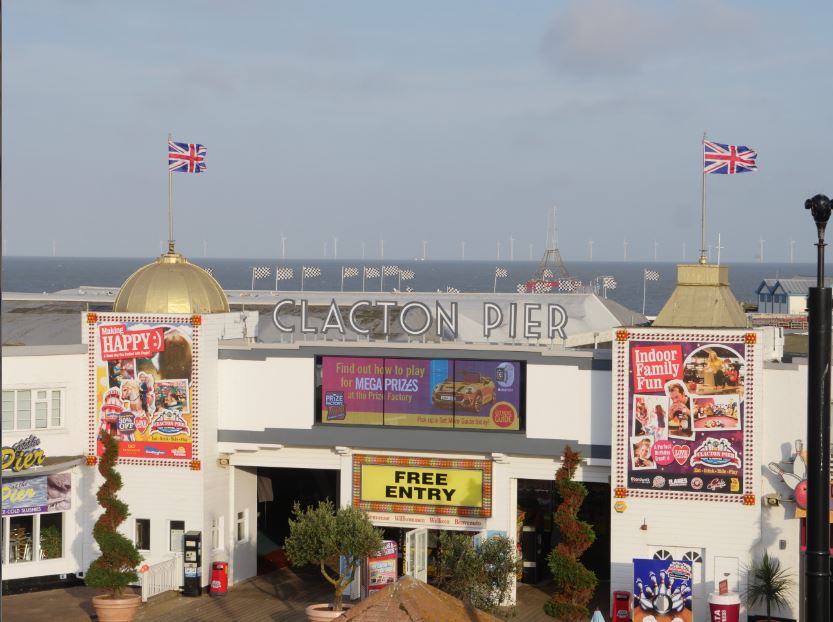

The landscape has also changed a bit with the offshore wind farm on Gunfleet Sands but all in all a pretty standard town that has had its ups and downs…

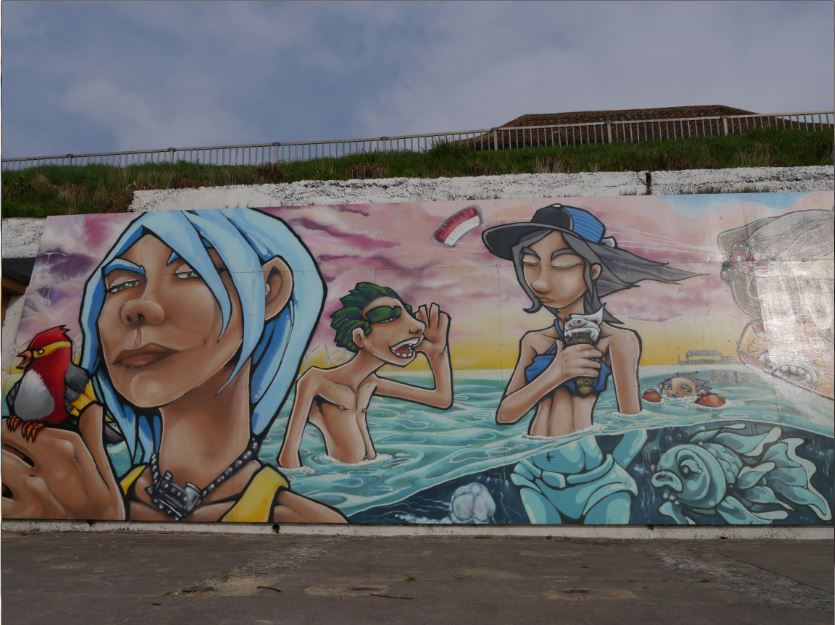
… Or is it?
Well, there are two things that are also uniquely interesting about this town, so let me explain.
Firstly, Clacton was the site of the first civilian casualties in World War II when Frederick and Dorothy Gill were killed by a Heinkel bomber that crashed into their house on May 1st, 1940. Little is made of this fact, although I clearly recall a plaque on a bench on nearby Skelmersdale Road detailing this tragedy when I was a teenager.
Secondly, although Clacton is primarily known as a typical Victorian seaside town, the area slightly inland at Great Clacton was inhabited by the Celts and there is some evidence of Roman involvement too at the coast. The most amazing fact though is that during the paleolithic period, the area was used for flint mining and tool manufacture. And in 1911 there was uncovered the “Clacton Spear” a wooden yew spear which, at 420,000 years old is the oldest known wooden tool created by man. It is, in fact, even older than Homo sapiens and was carved by our pre-ancestors Homo erectus. An entire period of human development, Clactonian, was named after the town and describes the fascinating industry of flint working and tool making.

How Quintessentially British!
It’s been over 7 years since we last visited the UK as a family and I thought our recent visit would be a great opportunity to write something about good old Blighty for a few posts. It will motivate me to process my photographs and also is relevant to promoting the art group I run at Quintessentially British, which now contains over 11,000 images of “Britishness” by more than 700 artists. Ironically, I haven’t posted that many images of my own to the group since I set it up 5 years ago, so this trip was an opportunity to get some more images to post!
So, I’ll start with our first port of call – literally – Southwick, in West Sussex.
Southwick is a small coastal town situated on the River Adur on the south coast of England. There have been settlements here from at least the Roman times and the town is first recorded in the Domesday Book (1085 AD). Like many nearby towns, it was the extension of the railway lines in the 19th century which really caused the town to expand becoming a popular place for tourists to visit and take the sea air.
Although largely eclipsed by Shoreham-by-Sea to the west and Brighton & Hove to the east, Southwick still has a thriving commercial port (called Shoreham Port, even though it’s really in Southwick and Fishersgate), serving both commercial and navy vessels in docks on the River Adur.


There is a nice village green with traditional pub on the edge, railway station and a couple of new windmills placed adjacent to the pebble beach, almost as an advance guard to the huge wind farm that is being developed off the coast in the distance.
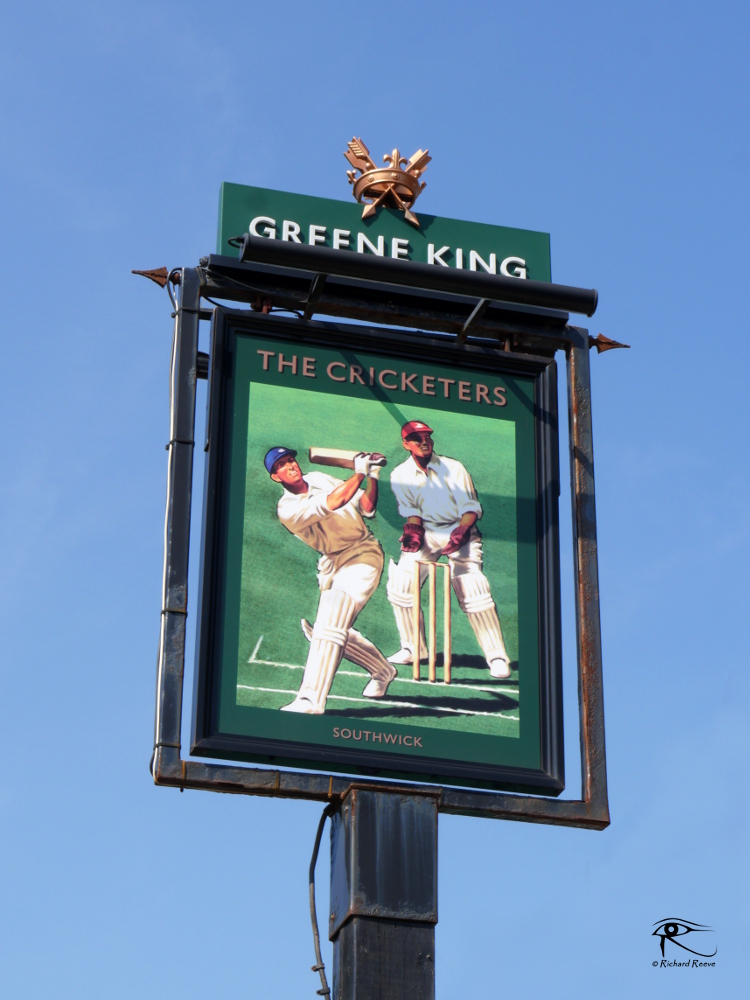


A bit of something for everyone, perhaps? Certainly a nice place to sit in the sun and enjoy a “99” (soft ice-cream cone with a chocolate flake).

How Quintessentially British!
Wow, it has been over a month since I posted a blog! I am appalled with this failure of what started out as a rebooted daily discipline, back in Jan 2016, but there’s been a good reason for this.
In mid-June I was fortunate enough to have taken an extended family vacation back to England and include a brief 2-night sojourn to Paris too. I had grand plans of writing blog entries and posting images as we traveled but, to be honest, I was too busy enjoying myself “in the moment,” as they say these days.
And that’s how it should be.
I will play a bit of catch up over the next few weeks and months as I process the hundreds of photographs I did take that will jog my memory. And I’ll start off with the first three that I worked on yesterday evening, from Brighton, Paris and Amesbury.


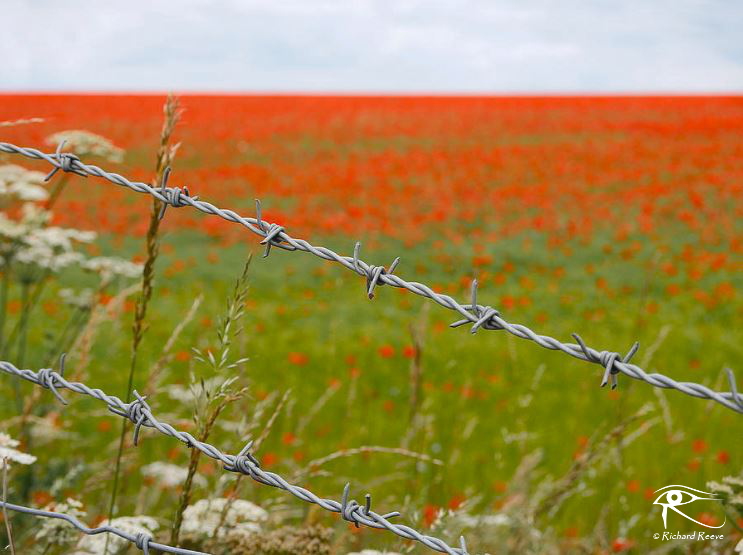
The time went very quickly and we saw family, several friends, and many of our old stomping grounds and tourist attractions. We were even fortunate with the notoriously unpredictable British weather.
It would have been nice to have stayed longer and spend more time with even more friends and family but, alas, time caught up with us and it was with mixed emotions that we returned to our home in Pennsylvania. After a day or so I admit that it’s good to be home and to appreciate the life that we have here.
That’s the philosophical part of traveling, perhaps!
Stuff that interests Mr Reid, a physicist and teacher
Sharing Great Blog Posts
Travelling the overcast isles
Inspiration for meeting life's challenges.
a resource for moving poetry
Welcome to my world.
Mind over matter
Musings on a mad world
Travel. Climbing. Characters. True stories, well told.
Adventuring the globe whilst based in the beautiful PNW, with a focus on fitness & adventure travel, conservation and a healthy balanced lifestyle. All with my beautiful partner in crime, Stephanie!
Games, Illustrations and Short Stories
Success By Design
Never get lost in the Sauce
Photo Book Store
Happy Eating
Cooking, gardening, traveling and photographing around the globe
storytelling the world
Perspectives on Lifelong Learning, Education, & The Arts
 searching4theshot