
As we struggle though another week of heatwave here on the East Coast, and watch the geopolitical storms unfurl around us, I thought I’d clear my mind and reminisce about sitting on Brighton Beach (or rather the pebbles) a few years ago.
Chill out!

Philosophical Photography, Percontation, Prose, Poetry, Parables, Pottery & Politics… Phew!
As we struggle though another week of heatwave here on the East Coast, and watch the geopolitical storms unfurl around us, I thought I’d clear my mind and reminisce about sitting on Brighton Beach (or rather the pebbles) a few years ago.
Chill out!
I have been very busy these last few weeks. Too busy, in fact to pay attention to this blog so I thought I’d cheat this time and ask Microsoft CoPilot AI to help me out by reviewing an image I took of our dog waiting in the sunlight on the top of the stairs of the AirBnB in which we stayed recently.
The resulting prose is interesting, sort of impressive, in a pseudo-philosophical way, and of course totally incorrect. See what you think, and roll your eyes:
Me: “write a blog post about the following image: https://reevephotos.com/featured/patience-richard-reeve.html”
CoPilot:
“Title: “Patience: A Reflection on Time and Stillness”
!Patience
In the quietude of a sun-dappled forest, where time seems to stretch and fold upon itself, we find “Patience.” This captivating photograph by Richard Reeve invites us to pause, breathe, and contemplate the delicate balance between movement and stillness.
The image transports us to a secluded woodland clearing. Shafts of golden light pierce through the canopy, illuminating the moss-covered ground. A gnarled tree stands sentinel, its twisted branches reaching skyward. The air is thick with anticipation, as if the very leaves hold their breath.
What is patience? It is not merely the absence of haste; it is an active surrender to the rhythm of existence. In this tableau, time slows down. The tree’s rings whisper stories of centuries past, and the ferns unfurl their delicate fronds at their own leisure. The sun, too, takes its time to caress each leaf, casting intricate shadows on the forest floor.
As we gaze upon “Patience,” we are reminded of nature’s wisdom. The tree teaches us resilience—the ability to withstand storms and seasons, to bend without breaking. The ferns teach us persistence—the gradual unfurling of potential, even in the darkest corners. And the sunlight, filtered through leaves, teaches us presence—the art of being fully here, now.
In our fast-paced lives, stillness is a rare gift. We rush from task to task, our minds perpetually racing. But here, in this forest glade, we glimpse the beauty of quietude. The tree does not fret about tomorrow; it stands rooted in the present. The ferns do not compare themselves to others; they grow at their own pace. And the sunlight, unburdened by clocks, bathes everything in its gentle glow.
“Patience” invites us to linger. To sit on the fallen log, feel the rough bark against our palms, and listen to the rustle of leaves. It asks us to release our grip on time, to let go of urgency, and to embrace the stillness that surrounds us. Perhaps, in doing so, we discover that patience is not a waiting game—it is a way of being.
So, dear reader, take a moment. Look at the photograph once more. Imagine the cool breeze on your skin, the scent of damp earth, and the whisper of leaves. Let “Patience” be your guide—a silent mentor in the art of living fully, one moment at a time.”

So, what do you think? Are we safe from the inexorable march of the machines for a little bit longer?
I have been learning Spanish for a while using Duolingo, in part to support my travels to Puerto Rico, Spain, and Uruguay. It’s an interesting way to learn vocabulary and set phrases, but on many occasions the examples it uses can be a little bizarre. Presumably this is to make the sentences stand out and stick in the memory.
That being said, over the last few days I have faced several screens which made me question whether Duo the perky owl who fronts the app is perhaps having an existential crisis. I provide my evidence in the order in which they were received over a few days:

The other question on my mind is “who was Pedro?” Does anyone have any suggestions?

We stumbled across this rather well composed street graffiti in Montevideo last winter (their Spring), and its construction of a 20 Peso banknote bearing the image of Juan Zorrilla de San Martín with added musical imagery intrigued me to conduct a little follow up research:
The image is of the poet, Juan Zorrilla de San Martín (1855–1931). However, he was much more than a poet; he was a beacon of Uruguayan identity. His verses celebrated the rugged landscapes, the gaucho spirit, and the resilience of a nation. His epic poem, “Tabaré,” immortalized the indigenous people and their struggles.
I am unsure as to the meaning that the artist wanted to impart to their audience through this juxtaposition, but I offer up the following verse by way of homage to both the poet and the street artist who pasted this to the wall:
In the city’s pulse, where concrete meets sky,
Whispers of poets and rebels never die.
Their ink spills onto walls, a silent plea—
Freedom, justice, love—their legacy.
Late one night, following the recent activities of the US Supreme Court (aka SCOTUS), and to some extent goaded by my watching of the recent John Oliver episode regarding the ethics of the Supreme Court, I was minded to create some SCOTUS-related art.
Referencing the official photograph of the current SCOTUS members I felt that a little iterative deconstruction would crystallize my mindset. I am pleased with the gloomy to ominous outcome of my digital manipulations and feel it illustrates a fractious, angular storm-cloud that sits and opines over the populace. However, that’s just my opinion, what do you think of the piece?

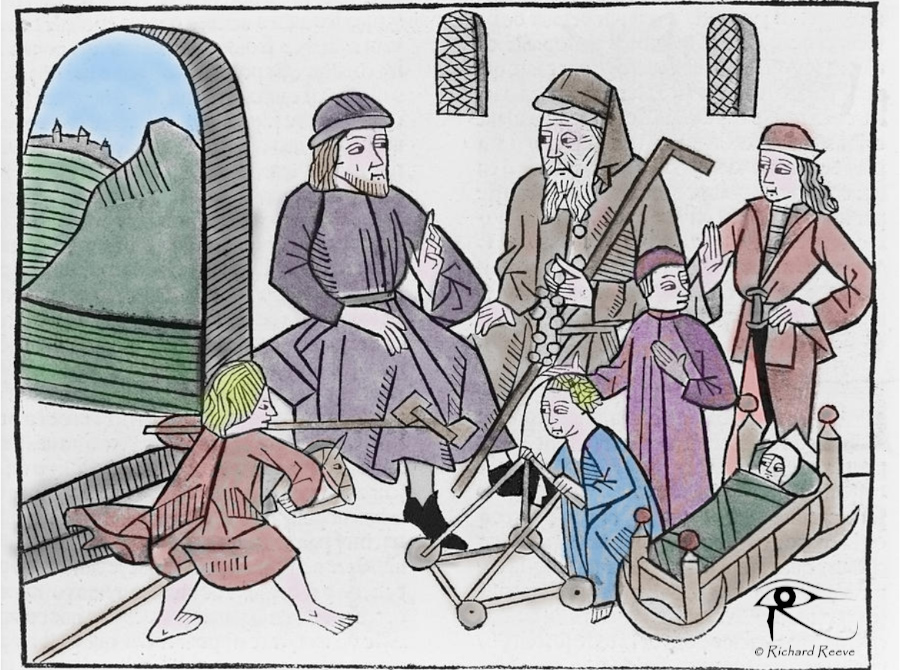
Several years ago, I would while away the late hours on the web looking for old artwork for inspiration, as a learning exercise and also to see if I could rework and give some a new life (if it was not copyrighted). An example of this is a digitally retouched and colored version of a woodcut by Bartholomaeus, Anglicus from 1486 AD.
This wonderful scene illustrates the artist’s perception on the various life stages of man, a subject that would later be depicted in William Shakespeare’s, As You Like It – Act II, Scene VII as the “seven ages of man.”
The original black and white lines of the image are clean and crisp, almost modern in their simplicity but I felt that adding simple coloring to the scene would make it pop a little. What do you think?
Wow, it’s already February 2nd! Where on earth did January go? After the year end festivities, I always find the first month of the year to seeming only be two weeks long, but here we are again.
I have written about quaint tradition of Punxatawney Phil a few times before and it seems fitting to make reference to those posts here now: Groundhog Day and Memories, Haiku: Groundhog Day, and Haiku ~ Groundhog Day. Heck, even the last two had the same title, which is kind of ironic.
Anyhow, today’s Badger-based festivities, the 138th, resulted in Phil not seeing his shadow, so I guess we’re in for an early Spring (unless, that is, you look at his predictive record of 39%). That being said, our snowdrops aren’t out yet so we’ll have to make do with an image I took a few years ago.

Happy Groundhog Day!

OK, I have been really lax with this blog and not written anything for a long, long time, but this is an important message for all and any readers.
This will not be the usual post, but I just wanted to get this out to people, especially following the President’s speech last night which was lackluster at best, and unforgivably misleading, at worst.
COVID-19 is here in the US. It has been spreading within the community for 15 days already, according to CDC.
Unchecked, the infection rate will be exponential, doubling every day or so.
It is more infectious and more fatal than the ‘flu, although it does affect older people much worse than younger people.
Younger people can spread it to older people, and we do not know the extent of the spread in the US yet since the CDC and FDA were woefully slow in closing to use their own test and releasing it too late.
Likely there are tens of thousands of people infected and spreading it already, possibly more.
It is important that people understand the seriousness of this situation.
The following article is a superb analysis of the pandemic:
Please Read This Analysis of the Coronavirus Impact
Please, please read it if you can. It not, or TLDR, then skip to Chart 23 at the and also read the text beneath.
Please take care, practice “social distancing” and #NowWashYourHands
~Richard
Haiku: Bootstrapping
The concept of bootstrapping, or “pulling oneself up by the bootstraps,” means to get yourself out of a situation by using the resources you have at hand. In computer parlance this has been shortened to “booting” and is the term used to describe when a system is initially activated and then starts up using existing hardware and firmware prior to loading the operating system.
Anyhow, I thought I’d extend this concept a little today using my iPhone’s predictive texting to generate a Haiku.
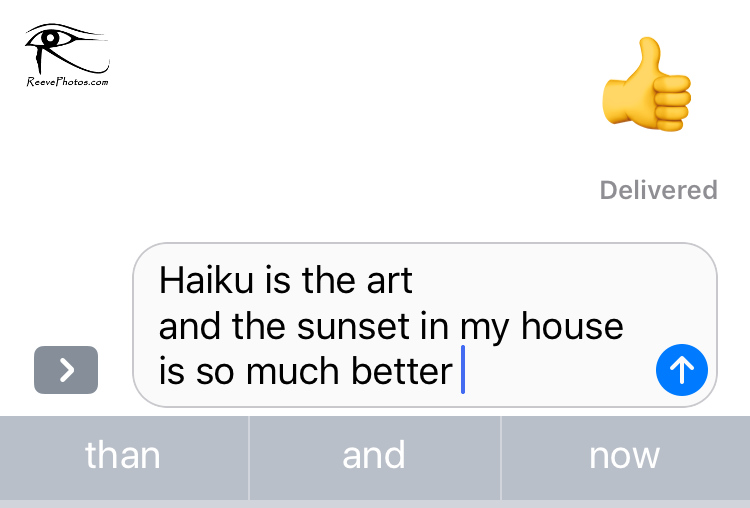
Staring with the word haiku, I selected one of the 3 suggested words that followed and repeated this until my bootstrapped haiku was created:
Haiku is the art
And the sunset in my house
Is so much better
And here’s the screenshot to prove it…
See more, listen well,
Positive thoughts for this year.
I am resolute.

~Richard
January, 2018
Stuff that interests Mr Reid, a physicist and teacher
Sharing Great Blog Posts
Travelling the overcast isles
Inspiration for meeting life's challenges.
a resource for moving poetry
Welcome to my world.
Mind over matter
Musings on a mad world
Travel. Climbing. Characters. True stories, well told.
Adventuring the globe whilst based in the beautiful PNW, with a focus on fitness & adventure travel, conservation and a healthy balanced lifestyle. All with my beautiful partner in crime, Stephanie!
Games, Illustrations and Short Stories
Success By Design
Never get lost in the Sauce
Photo Book Store
Happy Eating
Cooking, gardening, traveling and photographing around the globe
storytelling the world
Perspectives on Lifelong Learning, Education, & The Arts
 searching4theshot