What you feel, or why a painting is like a pizza

This is the first time I have composed a book review for this blog (I have reviewed hundreds of items on Amazon, but that’s another story), however, I felt compelled to mention this particular book simply because of the effect it has had on me, which has been little short of transformational.

I have been a photographer for several years and I maintain that the simple act of using a camera viewfinder and considering the composition of a shot has literally and figuratively opened my eyes on how I see the world. As someone with little formal art background and a career in a scientific world this subjective area of my life has always played “second-fiddle,” so to speak, to the practicalities of successfully raising a family in an ever-changing world.  

Recently we visited MoMA in New York and I was amazed by much of the artwork and confused by much of the more abstract works too. I was fortunate to visit another gallery the following day (The Frick Collection) with an extremely knowledgeable friend and, importantly, I listened as he explained the nuances of many of the historical art pieces on display.

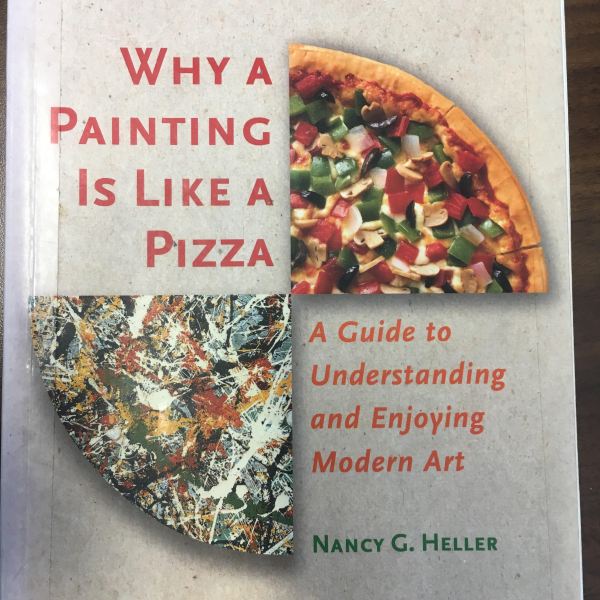
This outing spurred me on to visit my local library and the selection of the book, Why a painting is like a pizza, by Nancy Heller so that I may get to grips with contemporary art. I am so glad I did.

170121_ArtPizza.jpg

Heller’s introduction and simple comparison to real-world examples at the start of this relatively compact book suddenly made everything click into place. Working through the concise chapters and the color and monochrome plates I was drawn into the world of contemporary art through abstractionism and abstract art forms. I now have a much clearer understanding of these highly complex pieces of art and appreciate the why monochrome works and minimalist pieces can evoke responses in critics which appeared often insane to me, but a few short weeks ago!

To be honest, reading this single book, timed as it was with my gallery visits and friendly guidance, has been like an epiphany to me. Needless to say, I have now ordered a copy and I am sure I will keep coming back to it again and again. Heller’s work is by no means comprehensive, nor does it profess to be. It does however extend from painting to sculpture and installation art forms, and has certainly whet my appetite to explore more. I cannot wait to get back to MoMA and other art museums…

To paraphrase what I have learned from this small book:

“art is not what you see, but what you feel

~Richard


Stock Market Skylines

If you have been observing the online art world over the last few years you may have noticed just how popular have become city skyline silhouettes, often in dark colors but also as watercolors.

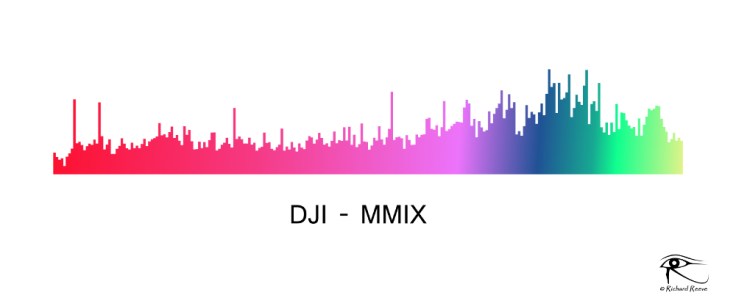
As graphic artwork they have a certain appeal and the other day as i was looking at the stock market online I noticed that the daily trade volume of shares could also be viewed as a sort of “skyline.” I have therefore created a series of graphic art images based on the volumes of shares traded daily on the Dow Jones Index tracker over an entire year.

It would certainly make for a conversation piece on the wall of a stock trader. Here’s the one for 2009 – what do you think?

161212_stockvolume

If you click the image it will take you to my art website and show you more from the series.

~Richard

Flip Top Head

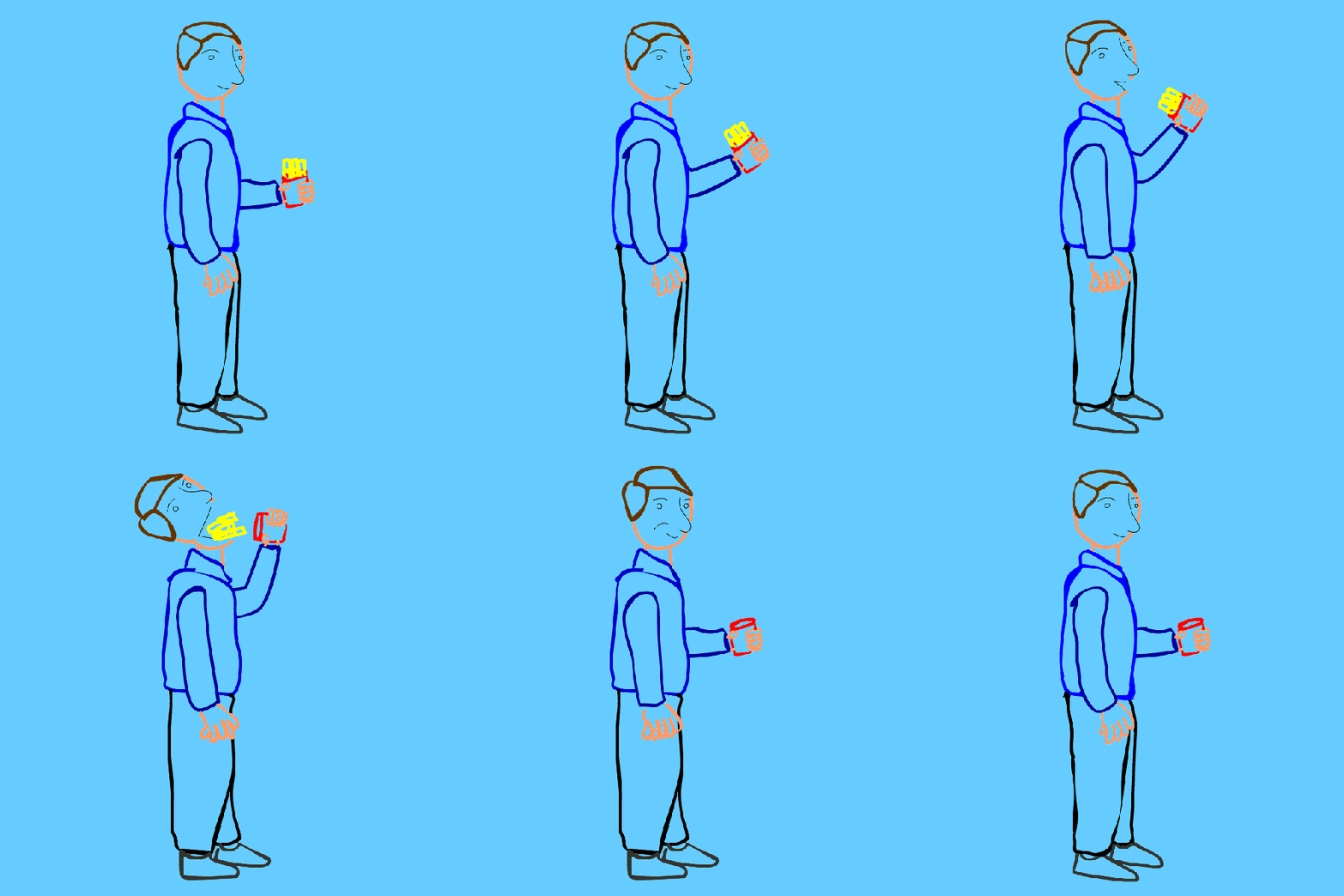
I admit it, have a problem. When I come home from work I am like some half-starved animal desperate to eat anything that I can my hands on. If I can find an opened bag of chips or some other savory snack then I will attack it and pour it down my throat to satisfy my need for crunchy carbs.

Weird thing is though, if the bags haven’t been opened I am able to resist the urge to do so. It’s almost like there’s a magical charm on them. It’s a bit like inviting a vampire into your house, once the invitation is there it’s a free for all.

This also gives me the excuse to blame other people for my piggish behavior. “If you hadn’t opened the bag, I wouldn’t be eating it,” I cry as a pathetic excuse.

Sometimes I feel as though I may as well have a flip top head…

20160824_fry_guy
~Richard

(*ChipGuy animation by Georgie)

DaDriver

I have been meaning to create this graphic for a while and finally got around to doing it after being on the periphery of yet another “shall we, shan’t we” conversation regarding a trip (or not) to one movie theater (or another) and what time to go. All this of course assumes that the in house chauffeur will drop anything he had planned and then deliver said daughter (via friend’s house for a pick up) to the theater and then will return at time to be confirmed for a repeat of collection and drop off.

So, for those under-appreciated soccer moms and dad drivers (which I concatenate to Dadriver) here’s a little tribute and reminder to our kids…

160514_DaDriver

~Richard

Friday Fun – Rolling Bone Magazine

Rolling Bone Magazine was an underground publication that championed the musical underdog for many years. Readership was strong throughout the 70’s and 80’s but tailed off after a scandal in the early 90’s before finally being buried by the arrival of online content.

Rolling Bone was unusual in that the issues were not dated, allowing for a sporadic output and also ensuring that copies always appeared to be current. This is a cover believed to be from late ’75 to early ’76 featuring Eddie “Howlin’ Jack” Russell shortly before his surprise first retirement from the music business at the height of his career.

Rolling Bone Magazine - ReevePhotos.com

~Richard

Politically Inspired Graphic Art

I have found the last several months of rhetoric, bombast, bigotry, and other political shenanigans that have poured forth during the run up to selection of political candidates for this year’s White House run to have been more depressing than usual. However, rather than simply getting angry, or demoralized I have used the time to inspire me to create some graphic art.

I make no public claim or overt political stand with this – the viewer can read into it whatever messaging s/he sees fit. Perhaps they would make for a good discussion too?

This is going to be a long year and I just needed to get this off my chest early in the game…

160129_GOPLiesFearThem

160129_GOPTee

~Richard

The Art of QR Codes

GX1_QRBlack

You have probably seen these weird looking blocks of black and white squares on packages and leaflets, and even on the billboards and buildings, but do you really understand what they are and how you can benefit from them as an artist?

What is a QR code?

Over the last several decades we have all become used to barcodes, with their characteristic zebra-stripes, being printed on all our packaging to make stock control easy in the supermarket and beyond, but in the last few years you may also have noticed the quiet arrival of a new variant of this object in the shape of a black and white set of dots in a square shape. This is a new form of 2-dimensional barcode called a Quick Response code, or QR code, which is able to convey a lot more information than the old stripey barcodes in a format that all users of common modern technology can use without a laser in sight. These squares of high contrast are not only used to identify a product but can also provide a quick link to a website for further information. Unique QR codes can, in fact, be created and used by anyone to allow quick access to anything accessible by a URL. This means we can now use them to drive potential customers to our online art portfolios, or even specific artwork, blog postings, or anything else  without worrying about spelling errors or mistyping of long web addresses.

How does it all work?

The first thing that anyone needs to be able to use a QR code is a smartphone with a camera and access to the internet. The next thing to do is to download an app that can read QR codes and then you are ready to start your journey. There are many QR code readers available for iOS and android users, some free (usually with a few, fairly unobtrusive adverts) and others that cost a few bucks. Just search your app store for “QR reader” and see what’s available.

Once you have this installed all you have to do is start the app, line the camera up with any QR code you find, and let the camera focus on it. You don’t even have to press the shutter button as the phone will do the rest for you. As soon as the app recognizes the QR code it will use your web browser to open up the page to which the QR code has sent it, and you can view the site.  It really is that quick and easy!

How to generate a QR code

It shouldn’t take you long to realize the potential for this as a marketing tool for your artwork. This little black and white square offers a foolproof way for people to quickly locate any page you want from their phone. All you have to do is generate your code and use it somewhere where others can find it.

Again, the web comes to our rescue, and a simple search for “QR code generator” will provide you with a wealth of choices. I use the google generator app so I will explain how this works, although other generators are very similar.

Go to the web page, and in the URL box type the web address where you want the QR code to point. This could be your artist site, personal site, even a specific gallery or image web address (just copy and paste from the address bar of your own site). You will see a QR code instantly generated for you by the software. You can even check the image now by pointing your QR scanner-equipped smartphone at your computer screen to see it work instantly!  Next, you save this code to your computer, usually as a PNG file for later use. With google you can also choose how big you want the image to be and also if you want margins (white space). It’s all personal choice and depends on what you want to do with it.

How to use a QR code

Now you have your personal QR code downloaded onto your computer – what next? Well, as a PNG file you can load it into your image processing software, word processor, or any other application that will accept an image. How you want to use this is really up to your own creativity.
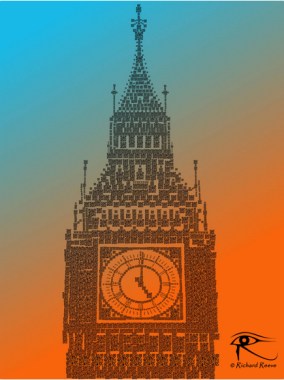
QR Pointillism - Big Ben I

I started off by printing it on cards and stickers to put on the back of my photographs and exhibition entries, along with my printed name and web address. Then I progressed to a self-inking stamp from VistaPrint (since this QR code can be uploaded as a logo) for a more professional look. By experimenting I found that the color of the image really has no effect on its usability so I have also created a few abstract images based on my QR code for my art gallery. Finally, I like to include it in any written work I do too. I have even defined this as one of my brushes in GIMP so I can include it in it any image I want as a watermark or overlay.

The bottom line is that QR codes can be interesting abstract images in themselves and can be used in any way you want knowing that every appearance is a subtle advertisement for your work!

If you are prepared to invest a relatively short amount of time learning how to use QR codes and a little more time thinking about how you can use them creatively. You could find them an inexpensive way of driving a few more potential customers to your online galleries.

~Richard

A Story – The Steampunk Moonlander

This is a rare find indeed! Discovered recently in a box of ephemera left as part of an eccentric recluse’s estate in Wensleydale, England, this is thought to be one of the fabled photographs that captured the largely apocryphal adventures of her forebear, Theophilus Carter.

Although Theophilus ostensibly made his living as a cabinet maker in Victorian Oxford, he was also of sufficient means to indulge his passion as an enthusiastic inventor. His initial setbacks with his more modest invention, the Alarm Clock Bed, first shown publicly at the Great Exhibition in 1851 met with such muted response that he was forced to continue his future activities hidden from public scrutiny through fear of criticism. In fact, such was his modesty that little is known of his later development of the steam space engine and his subsequent solo return trip to the moon in 1898.

He was blessed with sufficient foresight, however to carry photographic equipment with him on this adventure and I am pleased to be able to share with the public at large this remarkable image of the lunar surface, with waxing Earth and “The Brunel” rocket in the foreground.

160117-SteamPunkMoon

© Richard Reeve

Reinterpreting Public Domain Images

The recent announcement by The New York Public Library (NYPL) that it is to share more of its public domain (PD) images with the public has prompted this short entry on PD images and their use. PD images are, as the description suggests, images that have no copyright attached to them and are therefore “free” to be used by the public in any means, including commercial reselling or reworking. Images may have never been copyrighted, the copyright may have expired (not renewed) or they were donated into the public domain.

Despite the NYPL’s recent announcement the largest source of easily available PD work, to my knowledge, remains the US Library of Congress (LOC) with over one million searchable items arranged in collections, out of a total of 15 million items. This provides a fascinating source of information, not only for the historian, but also for the artist to use either directly or as inspiration.

Like many others, I have used PD images in several works on my art site. I find the LOC site easy to navigate and almost addictive as I search through items. Not everything that can be viewed on screen is always downloadable, but often times large .jpegs are available and even very high quality .tiff files, which allows for some excellent artistic opportunities.

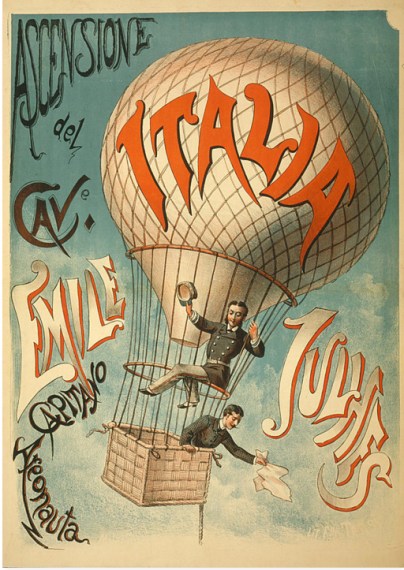
Generally speaking I don’t like to simply use the image “as is” but a quick google reverse image search shows that many people do just that, as they are legally allowed to. Instead I prefer to work on the image to some degree.This may mean just “cleaning up” the work, by removing scratches, dust and watermarks, and other artifacts, or it could be recovering details lost in the original, such as with this 19th century poster from the age of ballooning:

160116_PDimage1

Other approaches I take may include selectively recoloring the image to add emphasis to an aspect of a photograph. Many people colorize PD images with varying degrees of artistic interpretation, often over doing it, in my opinion. I prefer a subtle color application, as as I have achieved with this photograph of Santa Claus but, as with all art, it’s really a matter of personal preference.

160116_PDimage2

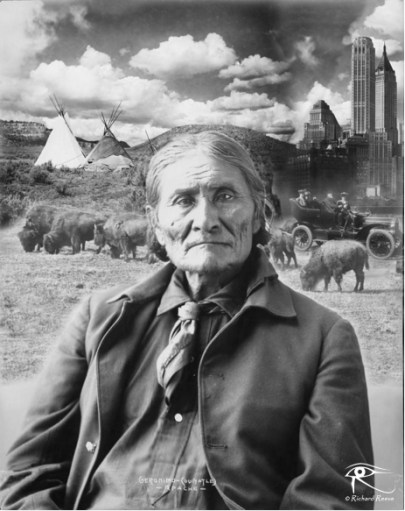
Finally, there is an opportunity to create a completely new artistic interpretation by blending imagery together to tell a new story. By way of example, I used the famous LOC image of an aging Geronimo together with four other photographs taken from his era and just thereafter to create this unique composite image to show how much America changed during the lifetime of one of its indigenous people:

160116_PDimage3

Note that by creating a completely new artwork, involving significant artistic interpretation and work the resulting image is no longer in the public domain and is now copyrighted by the artist (that’s me, folks).

Even if you don’t get as hooked on this source of history and art as I have done, it a least provides a fascinating way to see images of bygone days whilst browsing the library catalogs from your laptop.

~Richard

Corporate Dreaming – a perspective

Today my colleagues and I have the dubious pleasure of another 4 hour meeting with a group of management consultants who have been brought into our organization to tell us something. I am not entirely sure what we are supposed to gain from this exercise, as it wasn’t made clear during the first 2-day exercise, and a quick straw poll of several of my co-workers has revealed that they too are equally in the dark. However, as is often the case in such situations I am sure it will be seen as money well-spent by the corporation hierarchy. It baffles me how executive management of corporations are hailed as being successful managers and stewards of an organization when they need external consultants to do their job for them, but then as the old adage goes “no-one ever got fired for hiring McKinsey” (even when they do a poor job).

Anyhow, in an attempt to maintain my sanity in this ocean of madness what this means for me is that I have a credible excuse for posting some of my motivational irony that I have produced over the last couple of years, usually after similar exercises, so here goes:

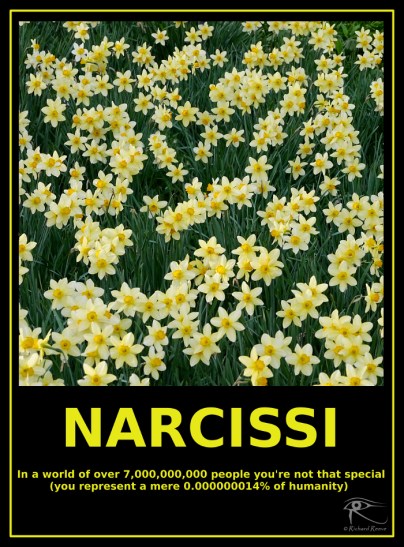
Firstly, I am tired of seeing bombastic scribbles which proclaim just how important we are as individuals, and how we should embrace this thought. To me this somewhat misses the point. Yes, individuals are important but we are only one tiny part of a greater society. Perhaps we should be reminded of this more often, and perhaps our seemingly ever increasing proclivity to narcissism may be held in check. We should be able to deal with this perspective.

160114_narcissi

The other hackneyed rhetoric to which we are often subject is to “think outside the box”. This truly annoying phrase has been with us since the advent of the management consultant and apparently has links to the old “nine dot puzzle” which is occasionally rolled out as if it is some kind of magic trick. As someone who solved this the first time I saw it, it never ceases to amaze me how many people who are proponents of the out of the box concept struggle with this simple puzzle and its derivatives (yes it can be done with 3 lines and even one line as long as it’s on a sheet of paper (big hint there). Anyway, I digress. My antidote to this, as a Whovian, is the following poster:

Think Inside The Box

And finally, to summarize my view of the whole management consultant affair, I offer the following picture to consider if you too also have to deal with hour after hour of meaningless metaphors sprinkled with irrelevant platitudes:

160114_tplatitudes

[rant over!]

~Richard

Blog at WordPress.com.

Up ↑

MrReid.org

Stuff that interests Mr Reid, a physicist and teacher

From 1 Blogger 2 Another

Sharing Great Blog Posts

Journeys Through Pre-World War 3 Britain

Travelling the overcast isles

cancer killing recipe

Inspiration for meeting life's challenges.

the poet's billow

a resource for moving poetry

Lordess

Welcome to my world.

Rustic Rumination

Mind over matter

Stephen Liddell

Musings on a mad world

thisisyouth

Travel. Climbing. Characters. True stories, well told.

OPOD blog

Adventuring the globe whilst based in the beautiful PNW, with a focus on fitness & adventure travel, conservation and a healthy balanced lifestyle. All with my beautiful partner in crime, Stephanie!

Fictionspawn

Games, Illustrations and Short Stories

2Richards, Inc.

Success By Design

Sauce Box

Never get lost in the Sauce

Jim Kayalar Photography

Photo Book Store

DADDYSCUISINE

Happy Eating

in cahoots with muddy boots

Cooking, gardening, traveling and photographing around the globe

P e d r o L

storytelling the world

The New Renaissance Mindset

Perspectives on Lifelong Learning, Education, & The Arts