A Story – The Steampunk Moonlander

This is a rare find indeed! Discovered recently in a box of ephemera left as part of an eccentric recluse’s estate in Wensleydale, England, this is thought to be one of the fabled photographs that captured the largely apocryphal adventures of her forebear, Theophilus Carter.

Although Theophilus ostensibly made his living as a cabinet maker in Victorian Oxford, he was also of sufficient means to indulge his passion as an enthusiastic inventor. His initial setbacks with his more modest invention, the Alarm Clock Bed, first shown publicly at the Great Exhibition in 1851 met with such muted response that he was forced to continue his future activities hidden from public scrutiny through fear of criticism. In fact, such was his modesty that little is known of his later development of the steam space engine and his subsequent solo return trip to the moon in 1898.

He was blessed with sufficient foresight, however to carry photographic equipment with him on this adventure and I am pleased to be able to share with the public at large this remarkable image of the lunar surface, with waxing Earth and “The Brunel” rocket in the foreground.

160117-SteamPunkMoon

© Richard Reeve

Reinterpreting Public Domain Images

The recent announcement by The New York Public Library (NYPL) that it is to share more of its public domain (PD) images with the public has prompted this short entry on PD images and their use. PD images are, as the description suggests, images that have no copyright attached to them and are therefore “free” to be used by the public in any means, including commercial reselling or reworking. Images may have never been copyrighted, the copyright may have expired (not renewed) or they were donated into the public domain.

Despite the NYPL’s recent announcement the largest source of easily available PD work, to my knowledge, remains the US Library of Congress (LOC) with over one million searchable items arranged in collections, out of a total of 15 million items. This provides a fascinating source of information, not only for the historian, but also for the artist to use either directly or as inspiration.

Like many others, I have used PD images in several works on my art site. I find the LOC site easy to navigate and almost addictive as I search through items. Not everything that can be viewed on screen is always downloadable, but often times large .jpegs are available and even very high quality .tiff files, which allows for some excellent artistic opportunities.

Generally speaking I don’t like to simply use the image “as is” but a quick google reverse image search shows that many people do just that, as they are legally allowed to. Instead I prefer to work on the image to some degree.This may mean just “cleaning up” the work, by removing scratches, dust and watermarks, and other artifacts, or it could be recovering details lost in the original, such as with this 19th century poster from the age of ballooning:
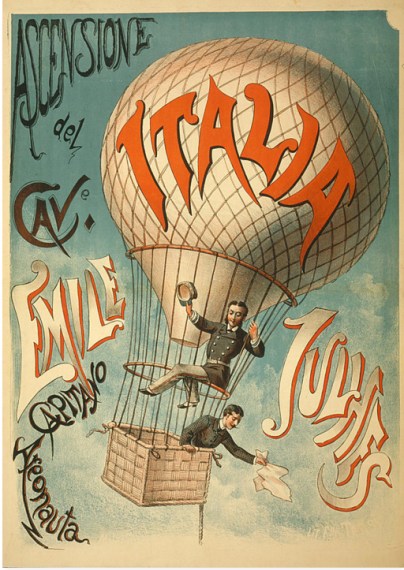
160116_PDimage1

Other approaches I take may include selectively recoloring the image to add emphasis to an aspect of a photograph. Many people colorize PD images with varying degrees of artistic interpretation, often over doing it, in my opinion. I prefer a subtle color application, as as I have achieved with this photograph of Santa Claus but, as with all art, it’s really a matter of personal preference.

160116_PDimage2

Finally, there is an opportunity to create a completely new artistic interpretation by blending imagery together to tell a new story. By way of example, I used the famous LOC image of an aging Geronimo together with four other photographs taken from his era and just thereafter to create this unique composite image to show how much America changed during the lifetime of one of its indigenous people:
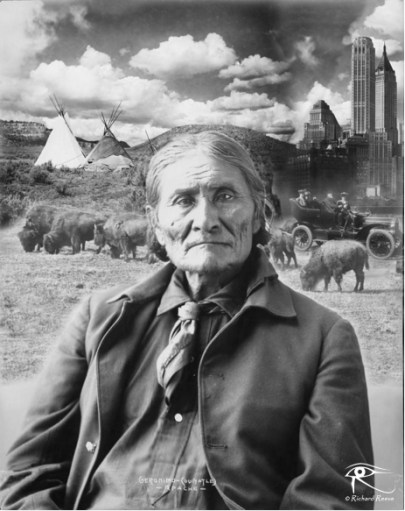
160116_PDimage3

Note that by creating a completely new artwork, involving significant artistic interpretation and work the resulting image is no longer in the public domain and is now copyrighted by the artist (that’s me, folks).

Even if you don’t get as hooked on this source of history and art as I have done, it a least provides a fascinating way to see images of bygone days whilst browsing the library catalogs from your laptop.

~Richard

Graphic Art – Gursky Redux

This is a digital pastel image created on a blank canvas and inspired by the most expensive photograph in the world, Rhein II by Andreas Gursky. It fascinates me that Mr. Gursky’s photoshopped image was able to command such a staggering sale price and my digital composition pays homage to his great skill. I am indebted to my wife, Michelle, for aiding me with pastel technique and allowing me to bridge the real and digital worlds to create a digital pastel image from scratch using the free image software, GIMP.

160112_Gursky

Background to the original work

Rhein II is a photographic image created by German visual artist Andreas Gursky in 1999. In 2011, a print was auctioned for $4.3 million, making it the most expensive photograph ever sold. (Although Peter Lik has reportedly sold an image entitled “Phantom” for $6.5 million in December 2014 this sale has not yet been verified).

The photograph was produced as part of a series of six depicting the River Rhine. In this image, of the second of the series, the Rhine flows horizontally across the field of view, between green fields, under an overcast sky.

Gursky digitally manipulated the original photograph to remove passersby and a factory building stating that “Paradoxically, this view of the Rhine cannot be obtained in situ, a fictitious construction was required to provide an accurate image of a modern river.” Gursky produced a very large chromogenic colour print of the photograph, mounted it onto acrylic glass, and then placed it in a frame. The image itself measures 73 by 143 inches (190 cm x 360 cm).

The print was originally acquired by the Galerie Monika Sprueth in Cologne, and subsequently bought by an anonymous German collector. The collector sold the print by auction at Christie’s New York on 8 November 2011, for $4,338,500 to an anonymous buyer.

The work has been described by arts writer Florence Waters in The Daily Telegraph as a “vibrant, beautiful and memorable – I should say unforgettable – contemporary twist on […] the romantic landscape” and by journalist Maev Kennedy in The Guardian as “a sludgy image of the grey Rhine under grey skies”.

Either way I thought it would be ironic to create a digital painting of this photograph in a retro-homage to this great artwork.

~Richard

Blog at WordPress.com.

Up ↑

MrReid.org

Stuff that interests Mr Reid, a physicist and teacher

From 1 Blogger 2 Another

Sharing Great Blog Posts

Journeys Through Pre-World War 3 Britain

Travelling the overcast isles

cancer killing recipe

Inspiration for meeting life's challenges.

the poet's billow

a resource for moving poetry

Lordess

Welcome to my world.

Rustic Rumination

Mind over matter

Stephen Liddell

Musings on a mad world

thisisyouth

Travel. Climbing. Characters. True stories, well told.

OPOD blog

Adventuring the globe whilst based in the beautiful PNW, with a focus on fitness & adventure travel, conservation and a healthy balanced lifestyle. All with my beautiful partner in crime, Stephanie!

Fictionspawn

Games, Illustrations and Short Stories

2Richards, Inc.

Success By Design

Sauce Box

Never get lost in the Sauce

Jim Kayalar Photography

Photo Book Store

DADDYSCUISINE

Happy Eating

in cahoots with muddy boots

Cooking, gardening, traveling and photographing around the globe

P e d r o L

storytelling the world

The New Renaissance Mindset

Perspectives on Lifelong Learning, Education, & The Arts