
As we struggle though another week of heatwave here on the East Coast, and watch the geopolitical storms unfurl around us, I thought I’d clear my mind and reminisce about sitting on Brighton Beach (or rather the pebbles) a few years ago.
Chill out!

Philosophical Photography, Percontation, Prose, Poetry, Parables, Pottery & Politics… Phew!
As we struggle though another week of heatwave here on the East Coast, and watch the geopolitical storms unfurl around us, I thought I’d clear my mind and reminisce about sitting on Brighton Beach (or rather the pebbles) a few years ago.
Chill out!
Today is the Summer Solstice of 2024 in the Northern Hemisphere. Colloquially, it’s the longest day although really all days are 24 hours in duration, so what we mean the most sunlight. It’s also known as midsummer, although it’s really only the beginning of the summer heatwave in my locale.
Today ought to be a positive day of reflection and as most of us aren’t Druids with access to Stonehenge to celebrate the sunrise or sunset perhaps we should just take a few minutes out of the day and reflect on all the good things that are going on in our lives.
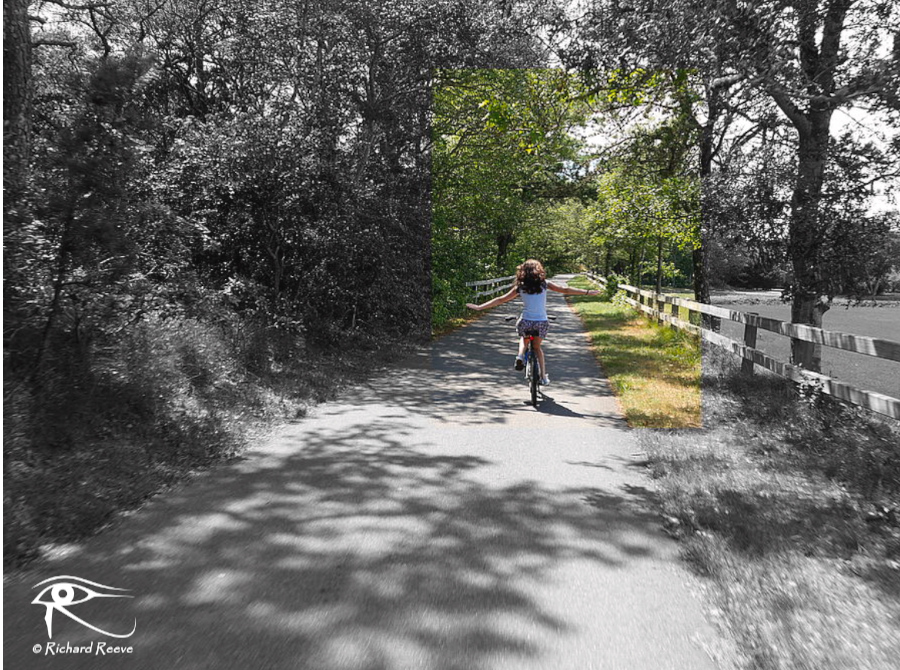
I was looking through an image to accompany this post and I found this one from 8 years ago which I think sums up a nice positive attitude.
Today is a day to just let go of the handlebars of life and embrace what is ahead of you!
I cannot believe I haven’t posted anything from my trip to Australia last year, so here’s a starting point in the form of a Haiku, based on an image that you may not expect from a tourist (although it is a lesser-known UNESCO Heritage site):
Steel giants stand tall,
Silent cranes against the sky,
Harbor whispers peace.

I have been very busy these last few weeks. Too busy, in fact to pay attention to this blog so I thought I’d cheat this time and ask Microsoft CoPilot AI to help me out by reviewing an image I took of our dog waiting in the sunlight on the top of the stairs of the AirBnB in which we stayed recently.
The resulting prose is interesting, sort of impressive, in a pseudo-philosophical way, and of course totally incorrect. See what you think, and roll your eyes:
Me: “write a blog post about the following image: https://reevephotos.com/featured/patience-richard-reeve.html”
CoPilot:
“Title: “Patience: A Reflection on Time and Stillness”
!Patience
In the quietude of a sun-dappled forest, where time seems to stretch and fold upon itself, we find “Patience.” This captivating photograph by Richard Reeve invites us to pause, breathe, and contemplate the delicate balance between movement and stillness.
The image transports us to a secluded woodland clearing. Shafts of golden light pierce through the canopy, illuminating the moss-covered ground. A gnarled tree stands sentinel, its twisted branches reaching skyward. The air is thick with anticipation, as if the very leaves hold their breath.
What is patience? It is not merely the absence of haste; it is an active surrender to the rhythm of existence. In this tableau, time slows down. The tree’s rings whisper stories of centuries past, and the ferns unfurl their delicate fronds at their own leisure. The sun, too, takes its time to caress each leaf, casting intricate shadows on the forest floor.
As we gaze upon “Patience,” we are reminded of nature’s wisdom. The tree teaches us resilience—the ability to withstand storms and seasons, to bend without breaking. The ferns teach us persistence—the gradual unfurling of potential, even in the darkest corners. And the sunlight, filtered through leaves, teaches us presence—the art of being fully here, now.
In our fast-paced lives, stillness is a rare gift. We rush from task to task, our minds perpetually racing. But here, in this forest glade, we glimpse the beauty of quietude. The tree does not fret about tomorrow; it stands rooted in the present. The ferns do not compare themselves to others; they grow at their own pace. And the sunlight, unburdened by clocks, bathes everything in its gentle glow.
“Patience” invites us to linger. To sit on the fallen log, feel the rough bark against our palms, and listen to the rustle of leaves. It asks us to release our grip on time, to let go of urgency, and to embrace the stillness that surrounds us. Perhaps, in doing so, we discover that patience is not a waiting game—it is a way of being.
So, dear reader, take a moment. Look at the photograph once more. Imagine the cool breeze on your skin, the scent of damp earth, and the whisper of leaves. Let “Patience” be your guide—a silent mentor in the art of living fully, one moment at a time.”

So, what do you think? Are we safe from the inexorable march of the machines for a little bit longer?
I have been learning Spanish for a while using Duolingo, in part to support my travels to Puerto Rico, Spain, and Uruguay. It’s an interesting way to learn vocabulary and set phrases, but on many occasions the examples it uses can be a little bizarre. Presumably this is to make the sentences stand out and stick in the memory.
That being said, over the last few days I have faced several screens which made me question whether Duo the perky owl who fronts the app is perhaps having an existential crisis. I provide my evidence in the order in which they were received over a few days:

The other question on my mind is “who was Pedro?” Does anyone have any suggestions?

We stumbled across this rather well composed street graffiti in Montevideo last winter (their Spring), and its construction of a 20 Peso banknote bearing the image of Juan Zorrilla de San Martín with added musical imagery intrigued me to conduct a little follow up research:
The image is of the poet, Juan Zorrilla de San Martín (1855–1931). However, he was much more than a poet; he was a beacon of Uruguayan identity. His verses celebrated the rugged landscapes, the gaucho spirit, and the resilience of a nation. His epic poem, “Tabaré,” immortalized the indigenous people and their struggles.
I am unsure as to the meaning that the artist wanted to impart to their audience through this juxtaposition, but I offer up the following verse by way of homage to both the poet and the street artist who pasted this to the wall:
In the city’s pulse, where concrete meets sky,
Whispers of poets and rebels never die.
Their ink spills onto walls, a silent plea—
Freedom, justice, love—their legacy.
Today’s posting started off as a rant, but after I read it I realized how boring it was. It was cathartic putting pen to paper, so to speak, so instead I converted my thoughts into a haiku:
Late train whispers lies,
Passengers wait, time stretched thin—
Hope clings to the rails.

In the heart of Montevideo, Uruguay, where the urban fabric weaves a tapestry of modernity and tradition, there lies a structure that defies the ordinary – Castillo Pittamiglio. With its eclectic façade and enigmatic presence, this “castle” provides a gateway to the past, as a monument that harbors tales of alchemy and mysticism.
Built by the architect and alchemist Humberto Pittamiglio, the castle stands as a testament to a life dedicated to the esoteric and the profound. From the outside, the building captivates passersby with a replica of the iconic Greek sculpture, the Winged Victory of Samothrace, emerging from a round brick tower, crowned by a coat of arms.
Stepping inside, you’re transported into a world where every corner whispers secrets of ancient wisdom. The castle’s history is shrouded in stories, some even claiming it once housed the Holy Grail. The interior is a labyrinth of rooms and corridors, each adorned with alchemical, Templar, Rosicrucian, and Masonic symbols. There are several puzzles and conundrums within the building which make you think deeply about the present and past.
Pittamiglio believed in the metaphor that life is a journey on a ship, and he reflected this in the castle’s never-ending construction, which continued until his death. It’s said that this was also a representation of the ‘wet path’ of alchemy.
In short, Castillo Pittamiglio is more than just a building; it’s a narrative woven into the fabric of Montevideo’s culture. It invites the curious and the seekers to explore its depths and perhaps, in its shadows, find a piece of the eternal quest for knowledge and transformation.

I have visited Washington, DC several times over the years but I must admit I had never walked around the Tidal Basin in its entirety and visited the Memorial to Franklin Delano Roosevelt. This tribute to FDR and his four terms as a US President is quite unusual. A strikingly different approach was taken in its design when compared to the somewhat more traditional (and arguably more photogenic) edifices built as homages to Presidents Washington, Lincoln and Jefferson.
FDR was an interesting president, hiding his disability at a time when it would have been considered weak to be anything less that an idealized “true man.” He was far from perfect, as the lack of dealing with racial equality on his watch attests, but he did make significant changes to the American way at a time of great turmoil and hardship, leading the nation through both the aftermath of the Great Depression and World War II.
The memorial is arranged to explore each of his four terms in office and, among the walls and sculptures contains several pieces of text carved into the marble. One of these quotes struck a chord with me for it’s prescience, and in my opinion, should also be reproduced over the doorway of the Oval Office so that every occupant, of every political persuasion, can contemplate it when seated at their desk.

We visited Washington, DC last weekend to catch sight of the early cherry blossoms. As we were enjoying a walk around the Tidal Basin near the Jefferson memorial we saw this withered cherry tree with flooded roots yet clinging to life sufficiently to put out some glorious blossom.
This is Stumpy, the beloved cherry tree that had apparently captured hearts as a symbol of resilience in the face of climate change. And s/he is bidding us farewell. The National Park Service announced that Stumpy, along with 158 other cherry trees, will be cut down to facilitate vital seawall repairs in the Tidal Basin and West Potomac Park.
Unfortunately, despite the emotional attachment to Stumpy, logic dictates the necessity of this decision. The deteriorating seawall poses a significant threat, leading to daily flooding that imperils not only the trees but also nearby monuments and public safety.
While the loss is poignant, there’s a glimmer of hope in Stumpy’s sacrifice. The removal will pave the way for the planting of 274 new cherry trees, ensuring a more secure future for this historical park. Stumpy’s legacy will also live on through cuttings ensuring that the tree’s genetic lineage continues.
Though his physical presence may fade, his spirit will endure as a reminder of the need for action in the face of climate challenges.
I took several photos and processed them in a variety of ways here but I am glad to have spent several hours creating this selective color version which I think emphasizes the beauty of Nature in adversity.

Stuff that interests Mr Reid, a physicist and teacher
Sharing Great Blog Posts
Travelling the overcast isles
Inspiration for meeting life's challenges.
a resource for moving poetry
Welcome to my world.
Mind over matter
Musings on a mad world
Travel. Climbing. Characters. True stories, well told.
Adventuring the globe whilst based in the beautiful PNW, with a focus on fitness & adventure travel, conservation and a healthy balanced lifestyle. All with my beautiful partner in crime, Stephanie!
Games, Illustrations and Short Stories
Success By Design
Never get lost in the Sauce
Photo Book Store
Happy Eating
Cooking, gardening, traveling and photographing around the globe
storytelling the world
Perspectives on Lifelong Learning, Education, & The Arts
 searching4theshot